Highlights from the Kyoto Conference 6: Savoring the “contingencies” around the roundtable: Experiencing the appeal of unscripted dialogue: Roundtable Part 1
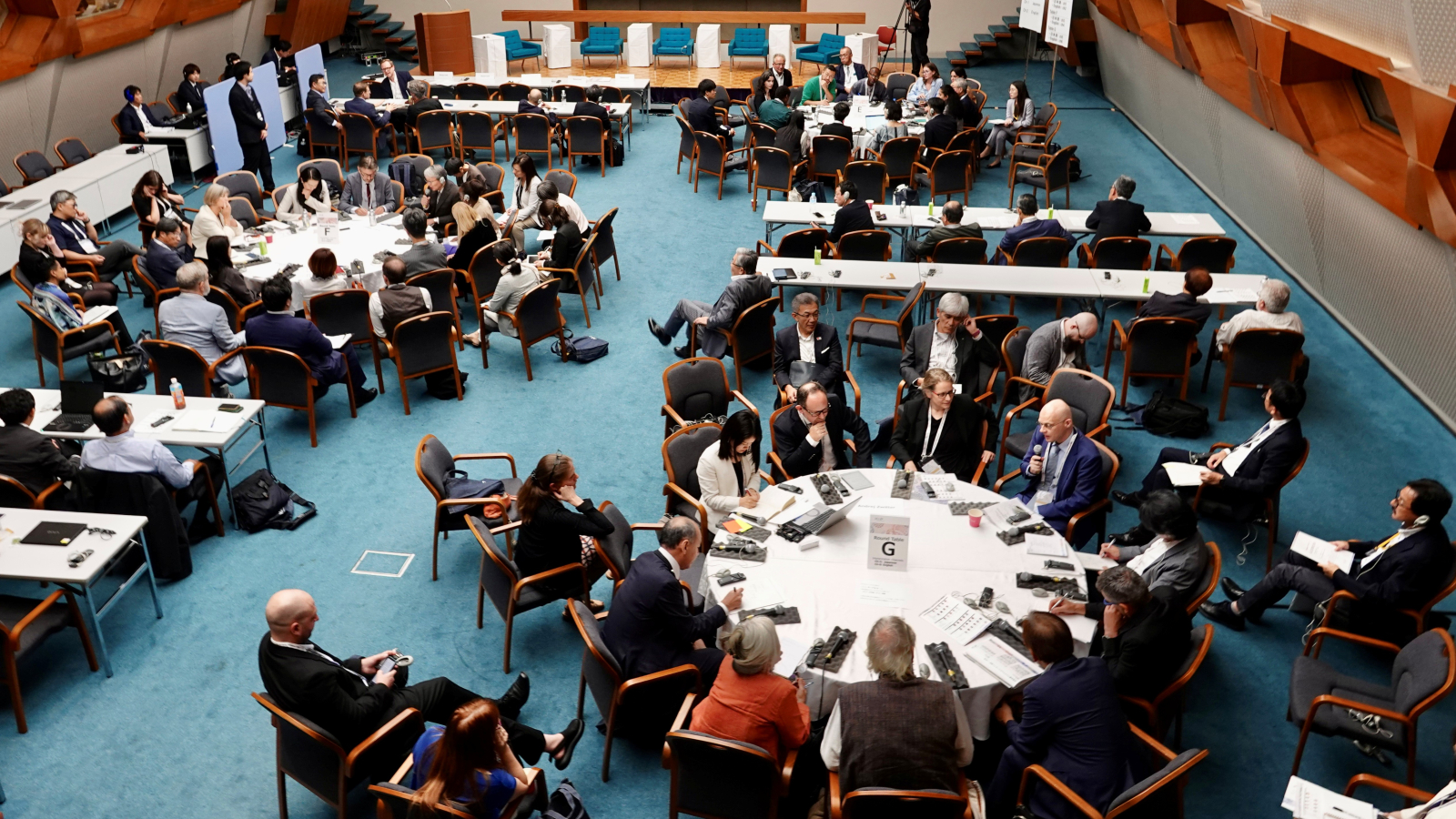
The roundtable sessions were designed as special venues where participants could directly experience the unique appeal of cross-disciplinary dialogue. Scheduled as “Part III” on the afternoon of the first day—when the Kyoto Conference naturally surfaces a wide range of issues—the session took “Horizons of Value Co-creation” as its theme. After 40 minutes of free discussion at each table, the discussion leaders took the stage for a 30-minute wrap-up panel to present and summarize the key points from their groups.
Details
Business leaders from finance, insurance, electricity, and media engage in lively discussion
The venue was divided into two large rooms: one housing Tables A–D, and the other Tables E–G. Chairs were arranged in concentric circles around each roundtable. Participants were free to choose any seat they wished—an intentional design that embraced the contingency that the tone of discussion would shift depending on who sat where.
What stood out in this open format was the enthusiastic contribution from leaders in the business sector. Executives from top companies voluntarily seated themselves close to the center and spoke candidly about the challenges and dilemmas facing their respective industries.
“It seemed to me that a consistent theme throughout today’s discussions was the importance of defining value and applying it in real social life and various contexts. I fully agree with that point.”
Chairman of the Board Makoto Takashima of Sumitomo Mitsui Financial Group, a participant at Table B, offered this summary of the day’s discussions. He continued:
“At the same time, when we consider what is happening globally—particularly the rapid advancement of technology—the key question is how specifically we define the purpose of technology and the values for which it is used. From a business standpoint, being able to explain that clearly is essential.”
At the same table, Tsuyoshi Nagano, Senior Executive Advisor at Tokio Marine & Nichido Fire Insurance Co., spoke about the relationship between business and AI:
“AI will probably continue to take over more of our everyday tasks. What only humans can do is to establish purpose—deciding what kind of society we want to design and what kind of better society we want to create. Education is extremely important for that.”
A major topic at Table A was also the use of AI in industry. Nobuhiro Endo, Executive Advisor at NEC Corporation and Vice Chair of Keidanren, remarked:
“Our computing power has grown tremendously, enabling us to work directly with data rather than information. We can generate answers based on extremely broad datasets. That means we are approaching overall optimization—something human society has never experienced before. I have some hopes for what this might enable.”
Meanwhile at Table C, Katsu Tsunoda, President of the Asahi Shimbun Company, addressed the decline in visitors to individual news sites due to the spread of AI search services. Since newspapers generate revenue not only through print sales but also through website operation, reduced site traffic threatens their financial foundation.
He commented: “In thinking about democracy or our ways of life, we rely on verified and substantiated information—and the media organizations that provide it are the original sources. How do we understand the potential depletion of such sources within an AI ecosystem? I hope this occasion will raise awareness of the issue as a societal challenge.”
AI training and data use also surfaced at Table A. Seiji Inagaki, Chair of the Board at Dai-ichi Life Insurance Co., stated:
“There is a pressing need to rethink our mindset: can we invest in companies that fail to protect intellectual property? Achieving this requires rethinking the design of our financial system, as the current capitalist framework does not allow us to shift our mindset accordingly. I would like us to consider this together.”
“What we must recognize are our unconscious values” / “Understanding promotes innovation”
At Table F, corporate leaders exchanged views using “values” as a central keyword.
Taro Shimada, President of Toshiba Corporation, noted:
“One thing I think is quite important is this idea of ‘unconscious value’—meaning there are things that people are not really noticing themselves, but you still have a certain value you are inclined to, and it’s actually quite difficult to discover that. So, when we say that we accept an opinion, we also have to understand that we have some kind of unconscious bias.”
Masahiro Kihara, President of Mizuho Financial Group, Inc., responded:
“Innovation comes from trying to understand the other side, which means that you have to admit that, first, you don’t understand—but you try to understand. And that probably promotes innovation.”
Listening to the exchange, Julia Longbottom, British Ambassador to Japan, commented from her perspective as a diplomat:
“We often use values as a shorthand for whether a country agrees with us about democracy, or whether it agrees with us about human rights or the death penalty— which are our friends in value, and which are not. I think this is a very unhelpful way to divide up our connections and ways of thinking. And the more we can stop to try to understand what lies behind different beliefs and values, the better.”
At Table D, Hirokazu Toda, Senior Advisor at Hakuhodo Inc., also spoke about values:
“I believe that new forms of communication and new media require new philosophy. When we consider the present and future of communication, we will likely need new axes of value—perhaps even new conceptions of humanity.”
Experts and scholars intersect: Reflecting on the light and shadow of AI
The roundtable sessions also featured many contributions from specialists in science, technology, and AI development.
At Table A, Anil K. Gupta, Visiting Faculty at the Indian Institute of Management Ahmedabad and Founder of the Honey Bee Network, spoke about the limitations of AI. Because AI can only learn from information available on the internet, it cannot capture the “tacit knowledge of elders,” nor the inner human dimensions of “aspiration, imagination, creativity.”
At Table B, Daisuke Okanohara, Chief Technology Officer of Preferred Networks, Inc., pointed out that in some subfields of life sciences and materials science, AI is already surpassing researchers’ capabilities, and the same is occurring in software development. “We need to consider how to accept such a circumstance in the future, in many fields,” he said.
At Table C, Naoto Ohtake, President and Chief Executive Officer of the Institute of Science Tokyo, offered an analysis rooted in his expertise in mechanical materials science:
“Humans currently understand only about 4% of the universe—in terms of mass. That means 96% remains unknown. AI cannot possibly understand it either.”
He continued, “If we recognize that neither humans nor AI understand very much about nature yet, then perhaps we can engage with AI in a more relaxed way,” a remark that lightened the atmosphere in the room.
(To be continued in Roundtable Part 2)
Others
Highlights from the Kyoto Conference 10: Praise for new approach to industry-academia dialogue, growing anticipation for the second Kyoto Conference: Closing session
2026.01.29
Highlights from the Kyoto Conference 9: Culture and the arts, where value begins: What perspectives are essential for building networks?: Panel discussions Part 3
2026.01.21