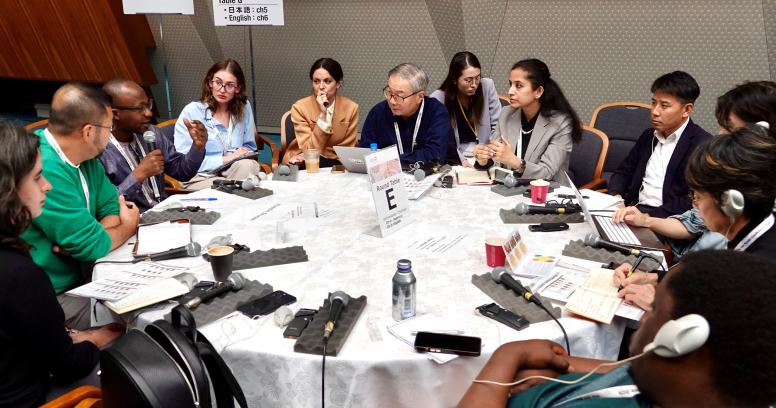
Highlights from the Kyoto Conference 8: Industry takes on philosophical debate: What are “capitalism” and “human relationships”?: Panel discussions Part 2
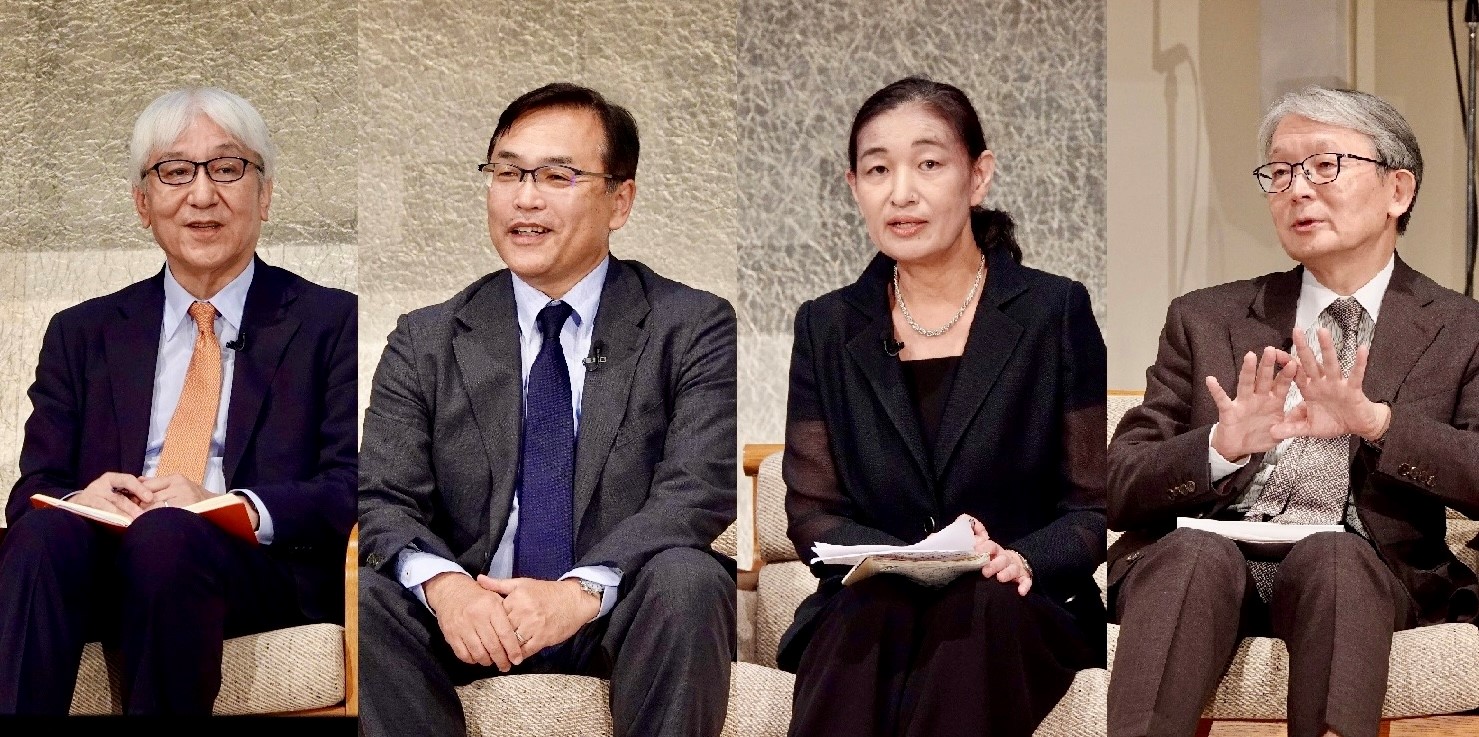
In Panel Discussions 1 and 2, positioned as Part I of the Inaugural Kyoto Conference, ten experts from the fields of philosophy, science, and the arts stepped into the business domain to exchange views. In the afternoon, Panel Discussion 3 reversed this vector: three panelists from the industrial world entered the academic domain and took on the challenge of philosophical debate with scholars. This was Part IV, which brought the first day to a close. The theme was “The Implementation of Value.”
Details
The Spirit of “Altruism” Embedded in Sanpō-yoshi —Bringing a Mutual Aid Perspective to Capitalism
One of the central themes of the discussion was “what capitalism ought to be.” Opening the discussion was Mutsuo Iwai, Chairperson of the Board of Japan Tobacco Inc., who also serves as Senior Vice Chairperson of the Japan Association of Corporate Executives (Keizai Doyukai).
“Tobacco is often said to have no benefits—it’s not something you eat, it has no nutritional value—so why do humans desire it? That is something I have been thinking about for a long time.”
Beginning with the commercial value of tobacco, Chairperson Iwai argued that “value is meaning for human beings,” and stated that the Multilayered Society of Values advocated by the Kyoto Institute of Philosophy resonates with the Collaborative Capitalism promoted by Keizai Doyukai. Collaborative Capitalism, he explained, is an approach that aims for an inclusive society through mutual support.
Meanwhile, Toshikazu Yamaguchi, President of The Yomiuri Shimbun Holdings and a director of the Kyoto Institute of Philosophy, presented his own views on capitalism from the perspective of what corporations can do to help ease the divisions emerging around the world. He pointed out that at the foundation of sanpō-yoshi—the business philosophy of the Ōmi merchants during the Edo period, meaning “good for the seller, good for the buyer, and good for society”—lay a spirit of consideration for others, including compromise and altruism. He remarked that a multilayered view of values, which respects the multilayered identities of individuals and societies, “can become a powerful way of thinking for making society and the world better.”
Chairperson Iwai responded by emphasizing that Collaborative Capitalism also shares common ground with sanpō-yoshi. “From the outset, the starting point has been to think about what we should do, based on something like the sympathy Adam Smith talked about,” he said.
At this point, Masaki Nomura, Executive Advisor to the Institute and moderator of the session, invited comments from Professor Markus Gabriel of the University of Bonn (Germany), who had been listening attentively to the discussion from the audience. He asked about the common ground between Ethical Capitalism, advocated by Professor Gabriel, and sanpō-yoshi and Collaborative Capitalism. Referring to Eiichi Shibusawa’s Rongo to Soroban (The Analects of Confucius and the Abacus), Professor Gabriel responded as follows:
“The win-win-win structure and the way of thinking of it is grounded in human interaction with other humans, other animals, and non-human nature. ... [This] is the way to go. And mutual-help capitalism is really the form capitalism itself.”
Panelist Takahiro Nakajima, Professor at the University of Tokyo, deepened the discussion by citing Chūshū Mishima, who served as a mentor to Eiichi Shibusawa.
“Mishima advocated what is called the unity of morality and profit. ‘Morality’ refers to ethical values such as rightness and goodness. ‘Profit’ was understood not merely as economic gain, but as value in a broader sense that includes altruism. When we think about corporate value today, I believe it is essential to pursue both morality and profit together.”
Professor Nakajima continued:
“There is a scholar at Oxford University named Colin Mayer. He says that ‘we must help those who help others.’ That, he argues, is the role of corporations. It’s an interesting way of putting it—help those who help others. I tried calling this ‘profit in the service of altruism.’”
Professor Nakajima argued that precisely because corporations exert such a significant influence on society, they should adopt a management stance that “benefits altruism.”
Deepening Relationships to Foster Trust / Human Bonds as a Powerful Force
Another philosophical theme discussed during this panel was human relationships.
Kumiko Oomori, Vice President, Office of Chief Executive Fellow at NTT, who is also a director of the Institute and has long been engaged in research and development, spoke about the importance of relationships using the example of the company’s generative AI, “tsuzumi.” According to Oomori, tsuzumi cannot match systems such as ChatGPT in terms of overall capabilities. To overcome this limitation, NTT advanced the development of the model by “creating many small AIs with heightened expertise and connecting them together to compete with GPT,” she said.
“Filling in what is lacking, including on the technological side, and forming such partnerships is what is required in our research and development at NTT,” Oomori emphasized, expressing the view that trust between people forms the foundation of innovation as well. She also shared that an encounter with Kitarō Nishida, who laid the foundations of the Kyoto School, had been what spurred her to study philosophy.
In connection with this, Chairperson Iwai referred to the mystery of emotions and the human mind.
“Can AI develop emotions or a mind? Is it only with such qualities that it could begin to coexist with humans? For me, these are questions with no clear answers.”
Professor Nakajima responded as follows:
“The mind is a very fascinating phenomenon, but I always think of it as a process. The idea that the mind is something a person possesses is absurd. Rather, for example, we have many people gathered here now, and at this moment we are sharing a mind. It is only through sharing that what Professor Deguchi calls the ‘WE’ emerges.”
President Yamaguchi noted that he has long been deepening his thinking on the role of journalism by reading works by the American philosopher John Dewey, who discussed the social role of the media. He observed, “The grand narratives that once gave order to the modern world have lost their persuasiveness, and before answers to this problem could be found, AI emerged and we broke into a post-human state of being.” Referring to Professor Nakajima’s line of inquiry, he cited Tetsurō Watsuji, who constructed ethics from the perspective of human relationships, and remarked:
“Trust is extremely important for us in the newspaper business as well, and I have read Watsuji’s works from that perspective. His ontology of aidagara (betweenness), which does not divide the self and the other, or view individuals and society as an antagonistic binary, but instead starts from the relationships between people—this way of thinking may well connect to what Professor Deguchi calls the WE-turn. If trust is emphasized, I feel we can move closer to a better society.”
Panel Discussion 3 came to a close, and after a wrap-up panel that broadly summarized the day’s discussions, all sessions of the first day concluded. The clock had passed 6:00 p.m., and dusk was settling over Kyoto. Panelists and participants moved to the dinner venue at the Kyoto International Conference Center, sharing reflections with glasses in hand. Frank, cross-disciplinary dialogue—this, too, was part of the “new human relationships” the Kyoto Conference sought to create.
Others
Highlights from the Kyoto Conference 10: Praise for new approach to industry-academia dialogue, growing anticipation for the second Kyoto Conference: Closing session
2026.01.29
Highlights from the Kyoto Conference 9: Culture and the arts, where value begins: What perspectives are essential for building networks?: Panel discussions Part 3
2026.01.21