Highlights from the Kyoto Conference 9: Culture and the arts, where value begins: What perspectives are essential for building networks?: Panel discussions Part 3
After a night’s rest, the Inaugural Kyoto Conference entered its second day. As late September set in, the morning air had grown noticeably cooler at the Kyoto International Conference Center, just north of central Kyoto. In Part V, titled “The Creation and Expression of Value,” four panelists engaged in discussion on the arts and culture—elements indispensable to the cultivation of humanity. This was followed by Part VI, the theme of which was “Prospects for the Future,” in which four experts with extensive experience in crossing borders and engaging in international activities held a panel discussion on the creativity which emerges from networks.
Details
Creation and imagination enrich human life: Illustrated through waka poetry and anime
One of the defining features of the Kyoto Conference was that it brought together participants not only from industry and academia, but also from the worlds of art, religion, education, and government, creating a space where diverse perspectives intersected. Together, participants confronted questions that cannot be resolved within any single domain.
Panel Discussion 4, held on the morning of the second day, was a clear example of this approach. Rich discussion emerged among panelists deeply versed in culture and the arts. The session was moderated by Professor Wiebke Denecke of the Massachusetts Institute of Technology (USA), a scholar of East Asian cultures and languages, including those of Japan and China. At the outset of the panel, Professor Denecke introduced Murasaki Shikibu (Lady Murasaki), who once lived in Kyoto and authored The Tale of Genji, and cited a waka poem. It was a poem of tragic love which is composed by the protagonist Hikaru Genji when he is accused of falling in love with Oborozukiyo, a lady-in-waiting of Suzaku, and is exiled to Suma.
The wind that waked you,
Came it from where my Lady lies,
Waves of the shore, whose sighs
Echo my sobbing?
(The Tale of Genji by Lady Murasaki; Translated by Arthur Waley)
Professor Denecke explained that even while enduring what she described as “one of the worst moments” of his life, Hikaru Genji continues to compose waka poetry and to play the koto and biwa. She emphasized that culture and the arts are “what makes us human beings,” noting that Genji creates “value” even amid the hardships of his secluded life.
Professor Rein Raud of Tallinn University (Estonia), a scholar of Japanese classical literature and Zen thought, remarked that we should recognize how art embodies “one of the most basic values of human life”: freedom. He continued:
“Our secular society has outsourced being free to artists. We have to cherish the artists because by being free, they also show us what is beyond our daily life, beyond the ordinary.”
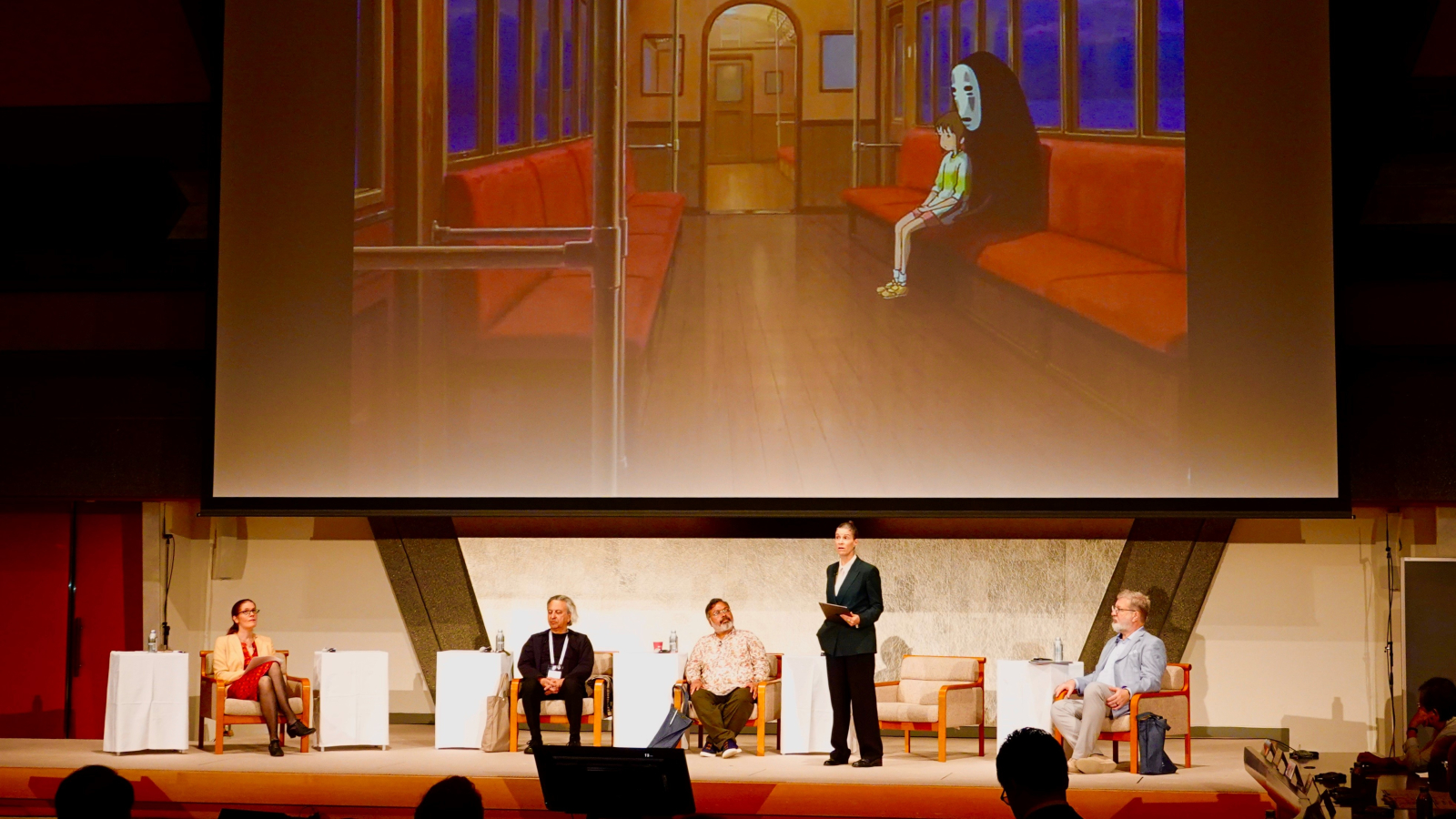
By contrast, Professor Laurie Ann Paul, a philosopher at Yale University (USA) with expertise in cognitive science, spoke about AI while displaying slides from the Japanese animated feature film Spirited Away. One image depicted the character No-Face, recognizable by its expressionless white mask and black-clad figure.
“I have No-Face here because I think we have to understand that AI—and what we will be creating in the future—can go either way. It can become a force for good, or it can become monstrous. But we can define it. We can work together and act together to ensure that the spirit of AI aligns with, embraces, develops, and supports our cultural and societal values.”
The focus of the panel discussion then shifted toward the importance of imagination and creativity. Professor Mohsen Mostafavi of Harvard University (USA), a distinguished architect, observed:
“It’s very hard to imagine things purely in abstract forms. But if you decide to learn how to make a model of a building, or how to make a drawing of a building, the drawing becomes the means through which you learn—you practice, in a way—the imagination.”
He emphasized that practice is essential to cultivating imagination. Indian mythologist Devdutt Pattanaik added that a rich imagination is also indispensable for cooperation among people, and continued:
“When you start comparing and contrasting stories, symbols, and rituals, you are forced to enter the minds of other people. You’re forced to look at the imagination of others—how they constructed their houses—and you realize that it is not based on logic; it’s based on aesthetics, emotion, and imagination. And you start to realize that others don’t think like you, and that, in a way, forces you to imagine.”
“Communities connect people”: Exploring the essence of networks
The Kyoto Institute of Philosophy positions the “formation of an international movement toward realizing a multilayered society of values” as a pillar of its activities. Organizations and groups that share common concerns form flexible connections, collaborating across borders and disciplines. The circles of solidarity thus formed are then linked with other circles. This is what is meant by a “Network of Networks,” the central theme of Panel Discussion 5.
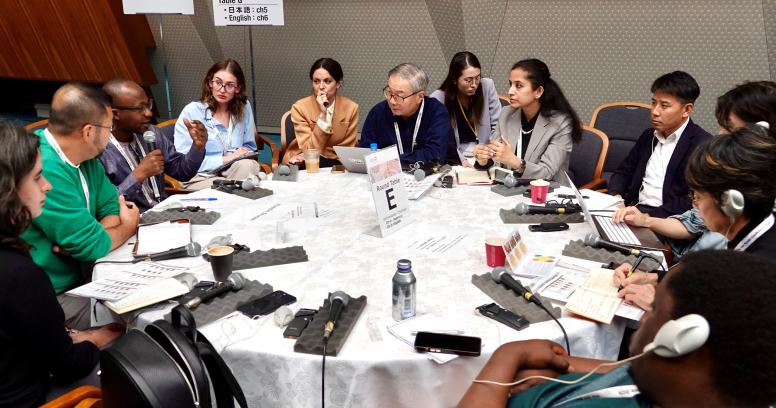
The panelists were Stéphane Decoutère, Secretary General of the Board of Directors of the Geneva Science and Diplomacy Anticipator (GESDA), based in Switzerland; Wakanyi Hoffman, Lead Researcher for Sustainable African AI Systems at the Inclusive AI Lab, Centre for Global Challenges at Utrecht University (the Netherlands), who researches the integration of the African philosophy of “Ubuntu” into AI systems; Guido Saracco, former Rector of Politecnico di Torino (Italy), who has led the planning and managing of the Biennale Tecnologia, an event which focuses on the relationship between technology and humanity; and Zoltan Somhegyi, Associate Professor at the University of Szeged (Hungary), an art historian who also serves as Deputy Secretary General of the International Council for Philosophy and Human Sciences. All four have been deeply engaged in international activities and have firsthand experience of the significance of networks.
During the panel discussion, Decoutère referred to the Institute’s proposed “ABC Model,” explaining that the purpose of establishing GESDA corresponded to “B” (Bridge) in the model—namely, “to bridge the world of science, politics, including diplomacy, business, and citizens.” As one outcome of “A” (Action), he introduced the “GESDA Science Breakthrough Radar,” an initiative that surveys scientific and technological developments with the potential to have a major impact on society. Producing the Radar, he noted, requires multifaceted analysis, and for that purpose GESDA has built a network of 2,500 scientists.
“This topic of networks is inherently tied to the question of what it means to be human.”
It was Hoffman who made this unequivocal statement. Born and raised in Kenya, and of Maasai heritage, she argued for the need to free the concept of networks from preconceived notions.
“A network is not a cable; it’s a community.”
According to Hoffman, networks are not formed merely by mechanical connections via telecom cables; rather, they emerge only when communities grounded in relationships take shape. She explained that this perspective resonates with Ubuntu—a relational philosophy often summarized as “I am because you are.” Ubuntu understands all living beings as equally connected through life force, with no “center.” Hoffman noted that this idea shares common ground with the concept of the “empty-centered WE” advocated by Professor Yasuo Deguchi of Kyoto University.
Others
Highlights from the Kyoto Conference 10: Praise for new approach to industry-academia dialogue, growing anticipation for the second Kyoto Conference: Closing session
2026.01.29
Highlights from the Kyoto Conference 8: Industry takes on philosophical debate: What are “capitalism” and “human relationships”?: Panel discussions Part 2
2026.01.15