Highlights from the Kyoto Conference 10: Praise for new approach to industry-academia dialogue, growing anticipation for the second Kyoto Conference: Closing session
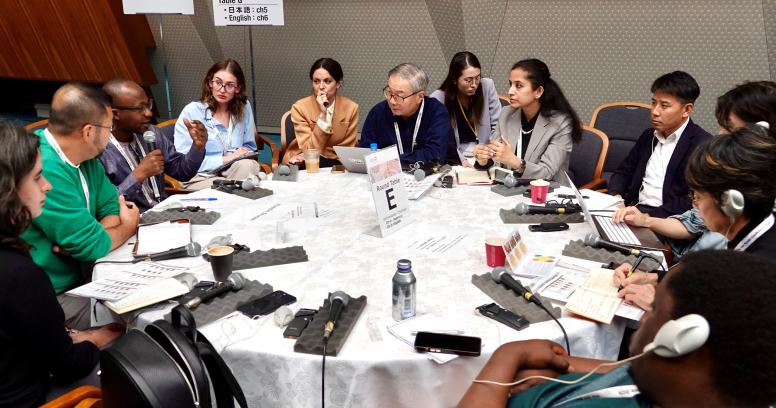
Two keynote lectures, nine panel discussions including lunch sessions, and roundtable sessions where participants gathered around circular tables to exchange views openly and without barriers. For two days, the Inaugural Kyoto Conference offered a wide range of sessions and served as an experimental forum for close, face-to-face dialogue between industry and academia. How will it be remembered by those who took part? In the concluding Panel Discussion 6, five experts who had served as moderators across the various sessions reflected on the discussions, commented on the outcomes achieved, and shared their expectations for the second Kyoto Conference.
Details
“Add a ‘D’ to the ABC model,” “Make life and education key themes” — Lively proposals from participants
“You are really the frontrunner in putting out a bold vision, in bringing the people there, in making it happen, in creating a space where we all need to take time and can actually listen to each other. How precious is that, no?”
So said Professor Wiebke Denecke of the Massachusetts Institute of Technology (USA), who served as moderator of Panel 4. Denecke pointed out that one of the “values” of the Inaugural Kyoto Conference lay in the fact that participants from not only industry and academia, but also the worlds of art, religion, education, and government crossed boundaries to engage in dialogue. She also praised the ABC Model presented by the Kyoto Institute of Philosophy, suggesting that elements such as Dialogue and Diplomacy are equally important and proposing that a “D” be added to the ABC framework.
Professor Noburu Notomi of the University of Tokyo, who led the discussion in Panel 1, shared a question that he felt must be reexamined through cross-disciplinary dialogue.
“Science and technology are based on some kind of historical and cultural philosophy. Then are they purely neutral, or universal? This is the question we again have to consider,” Professor Notomi said.
Building on this, Professor Notomi offered a constructive proposal: that future conferences should not only continue discussions on AI, which was a major topic this time, but also take up specific themes such as life, disease, and education.
Meanwhile, Professor Mathias Risse, a philosopher at Harvard University (USA) who moderated Panel 2, observed that humanity now finds itself at an “inflection point” from a macro-historical perspective. Citing urgent global challenges such as climate change and poverty, he argued that we must act swiftly and in solidarity to address these issues precisely because “we know enough, we have enough resources, and we have enough capacities” to meet these challenges.
Beyond monism and dualism: Toward diverse and plural endeavors
With this, all panel discussions came to an end. In the closing session reflecting on two days of dialogue, Professor Yasuo Deguchi of Kyoto University and Jun Sawada, Executive Chairman of NTT — both co-chairpersons of the Institute — together with Professor Markus Gabriel of the University of Bonn (Germany), Senior Global Advisor to the Institute, responded to questions from participants.
One question from the floor asked about the Institute’s position on dualistic ways of thinking that frame everything in terms of oppositions such as “the West and the East,” as well as monistic approaches that fail to acknowledge differences with others. The three speakers responded as follows.
Professor Gabriel: “Is Japan in the West? Is it in the East? Japan is always a great example of how this is, I think, just a useless concept.”
Chairman Sawada: “Industry carries contradictions and tends to apply Western-style judgments about how to trade them off. But in reality, that alone is no longer sufficient. I understand that the next challenge will be whether the kind of discussions we had here can be applied within industry.”
Professor Deguchi: “The WE-turn itself is something created by moving back and forth between Japanese and English, so even I, who created the concept, do not know where Japanese ends and English begins. In the end, we can only overcome this through a movement [i.e., a recurring back-and-forth between “diving” toward the root causes of the problem and “surfacing” to envision the future from new values], by entering into that movement and going beyond it.”
There was also a question about the Institute’s distance from politics. In response, Chairman Sawada explained, “This time we did not invite participants from the Middle East, China, or Russia. In creating this forum, we began by asking whether it was possible to discuss the ABC Model and the multilayered society of values.” He expressed an intention to broaden participation in stages. Related to this, at a post-conference press briefing, Chairman Sawada was asked whether dialogue with figures such as Sam Altman, CEO of OpenAI (USA), known for developing the conversational AI service ChatGPT, might be possible. He answered affirmatively — “I think we will include them.”
He added: “However, if everything turns into a power game, we end up in a fairly homogeneous world, a monistic one. I believe that structures which emphasize quality over quantity and value diversity are healthier, and my understanding is that the Kyoto Conference brings together people who base their thinking and management on such principles.”
We dialogue, therefore we… — The second Kyoto Conference to be held in the summer of 2027
Toward the end of the closing session, a participant proposed a “motto” for the Inaugural conference, inspired by René Descartes’ foundational principle of modern philosophy, “I think, therefore I am.”
“As a motto for this conference, I suggest: ‘We are dialoguing, therefore we are becoming a network.’ Professor Deguchi, may I ask for your comment?”
Professor Deguchi, who had been listening with a nod, broke into a broad smile and replied: “I would like to take what you have just said as the conclusion of this conference. I’ll take the copyright.”
As laughter and applause filled the room, Chairman Sawada concluded by sharing his aspirations for the next conference, bringing the Inaugural Kyoto Conference to a close.
“I am truly grateful for the very active communication we were able to have. We are thinking about holding the second Kyoto Conference in two years’ time, and next time I would very much like us to work toward creating a declaration from Kyoto that we can present to the world. Thank you very much.”
To accelerate the momentum toward realizing a 'Multilayered Society of Values,' the Institute is preparing to hold the second Kyoto Conference in the summer of 2027 and to issue a “Kyoto Declaration.”
Others
Highlights from the Kyoto Conference 9: Culture and the arts, where value begins: What perspectives are essential for building networks?: Panel discussions Part 3
2026.01.21
Highlights from the Kyoto Conference 8: Industry takes on philosophical debate: What are “capitalism” and “human relationships”?: Panel discussions Part 2
2026.01.15