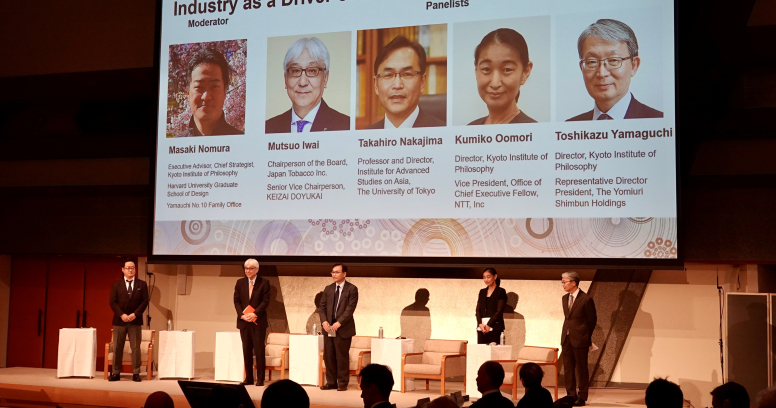
Highlights from the Kyoto Conference 7: Around 70 participants share perspectives in an international setting — small-group dialogues embodying an “empty-centered” approach: Roundtable Part 2
The roundtable sessions were held through mutual dialogue among participants at seven tables across two venues. Around 70 participants from Japan and abroad, spanning both industry and academia, actively contributed, resulting in rich and cross-disciplinary discussions. Following the report article “Roundtable, Part 1,” we present selected highlights here.
Details
“WE-turn” and “Universality” — Three international scholars frame the key issues
In one room, where three tables (E through G) were arranged, a distinctive format was adopted at the outset. Three scholars who would guide the discussions at each table took the stage and spoke for five minutes each, providing participants with a shared “seed for discussion.” This format was devised through careful deliberation by Rector Tõnu Viik of Tallinn University (Estonia), Professor Andrej Zwitter of the University of Groningen (the Netherlands), and Associate Professor Husein Inusah of the University of Cape Coast (Ghana), with the aim of fostering meaningful exchanges. While this differed from the approach taken in another room, where discussions began independently at each table, it proved helpful in sharpening the focus of the dialogue.
On the stage, Professor Viik spoke about the “WE-turn,” a concept advocated by Professor Yasuo Deguchi of Kyoto University, who also serves as Co-chairperson of the Institute.
“For me, the idea sounded like the need to reconsider the notion and, actually, the culture of dialogue. It also sounded to me like a call to reconsider the leadership function in enterprises, in organizations, and in universities. And also, I considered it an attempt, again, to shape or reconsider the culture of the public sphere—the way we talk to each other in a democratic society, in the open sphere of the media.”
His remarks conveyed a clear invitation for participants to reflect once again on the WE-turn mode of thinking as they engaged in discussion.
Professor Zwitter addressed the theme of universality. He argued that, in addition to three elements—“agreement among people,” “social and economic necessity,” and “physical and biological necessity”—there exists a fourth: the “universality of partaking in universals.” He pointed out that this fourth element is “least discussed.” His remarks returned to themes raised earlier that morning in the panel discussion, in which Professor Emerita Heisook Kim of Ewha Womans University (Korea) and Emeritus Professor Michael Neocosmos of Rhodes University (South Africa) had spoken on universality.
Professor Inusah also focused on universality. Drawing on his expertise in African politics and culture, he explained that, from an African perspective, the concept of universalism carries a dual character. One is “perverted universalism,” which involves “imposing certain forms of particulars on other cultures.” The other is “normal universalism,” referring to “cross-cultural ideas that we all share, like mathematical axioms and the fact that we are all humans.” He noted that “the perverted universalism assumes the idea of neutrality—the idea that we should erode differences and be indifferent to them,” and emphasized, “this idea itself has not been properly tackled. That is, from my point of view, from the Global South—especially from parts of Africa.”
The opening statements by the three scholars served as a catalyst, prompting deeper discussions at each table around themes such as the WE-turn and universality.
Participating in the discussion via an avatar robot — Mr. Nagahiro, living with spinal muscular atrophy
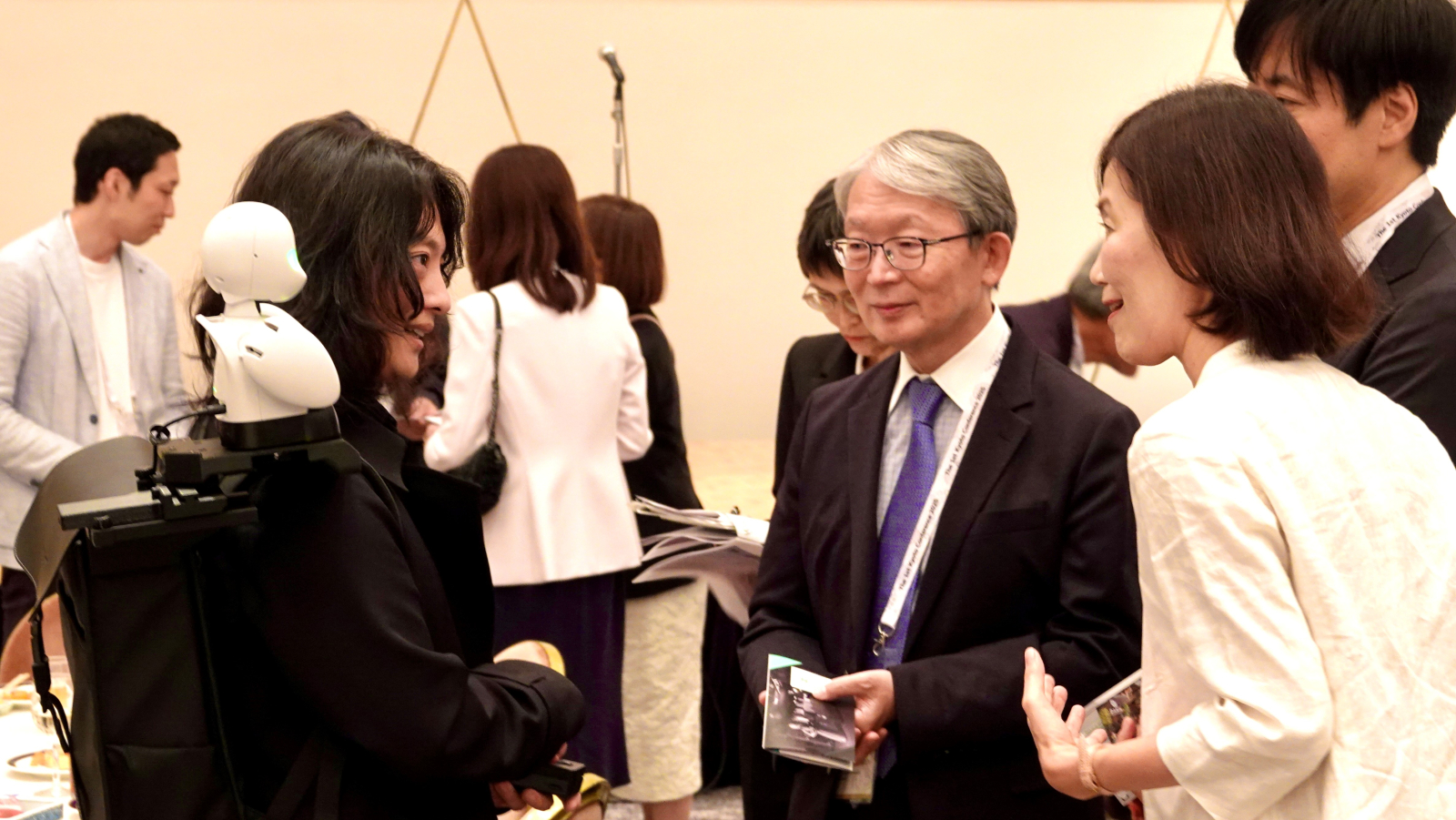
One participant at Table D attracted particular attention: OriHime, an avatar robot remotely operated by Mr. Masato Nagahiro from Tokyo.
Mr. Nagahiro lives with spinal muscular atrophy (SMA), a rare disease that causes progressive loss of muscle strength and has left him bedridden. Through sensors that detect eye movements, however, he is able to operate OriHime and communicate with people at a distance using the robot’s built-in camera and speaker. Director Ory Yoshifuji of OryLab Inc., the developer of OriHime, attended the Kyoto Conference with a compact OriHime perched on his shoulder, while Mr. Nagahiro joined the circle at Table D by operating it remotely.
“While thinking that it would be great if more and more people could do more things by making good use of technology, yes, today I’d like to listen to everyone’s opinions and learn from them. Thank you very much.”
Participants warmly welcomed Mr. Nagahiro’s words.
In his daily life, Mr. Nagahiro operates one of the OriHime units at a café in Nihonbashi, where avatar robots work as staff—taking orders and engaging customers in conversation. There are frequent mishaps, such as the mobile OriHime tipping over and becoming inoperable due to control errors. Director Yoshifuji, who has devoted himself to research for more than 15 years since his university days after experiencing school refusal, believes that human value lies precisely in failure.
“In an era when robots take on physical labor and AI takes on intellectual labor, what is the value of what humans do? What kind of work will remain? We are experimenting with that.”
This perspective resonates with Professor Deguchi’s WE-turn thinking, which considers human relationships not from what we can do, but from what we cannot do. Prompted by Director Yoshifuji’s remarks, the discussion at Table D gradually converged on the tendency within Japanese industry to avoid failure and risk. Sitting beside him, Aki Yuki, Co-founder of OryLab, remarked:
“Unless we actually experience failure when implementing something in society, it won’t become something that can truly be used within society. When we return to AI, risks are strongly emphasized, and while failures in the laboratory are tolerated, failures after social implementation are not. That prevailing attitude is something I find slightly concerning.”
“Being able to engage actively” — High praise from participants
Post-conference feedback from participants reflected strong appreciation for the roundtable sessions.
“I found it meaningful that I was able to engage actively and participate in discussion.”
“I was able to learn directly about perspectives from different cultures, and it felt different from other conferences.”
These small-group dialogues, reminiscent of traditional circle gatherings, can be seen as embodying the concept of “empty-centeredness” proposed in the keynote lecture by Professor Deguchi, Co-chairperson of the Institute. Positioning this format as one of the defining features of the Kyoto Conference, the Kyoto Institute of Philosophy hopes to continue the roundtable sessions at the second conference as well.
Others
Highlights from the Kyoto Conference 10: Praise for new approach to industry-academia dialogue, growing anticipation for the second Kyoto Conference: Closing session
2026.01.29
Highlights from the Kyoto Conference 9: Culture and the arts, where value begins: What perspectives are essential for building networks?: Panel discussions Part 3
2026.01.21