
‘Horizon of hope’ guided by philosophy: KIP and University of Tokyo hold symposium to discuss human and technology
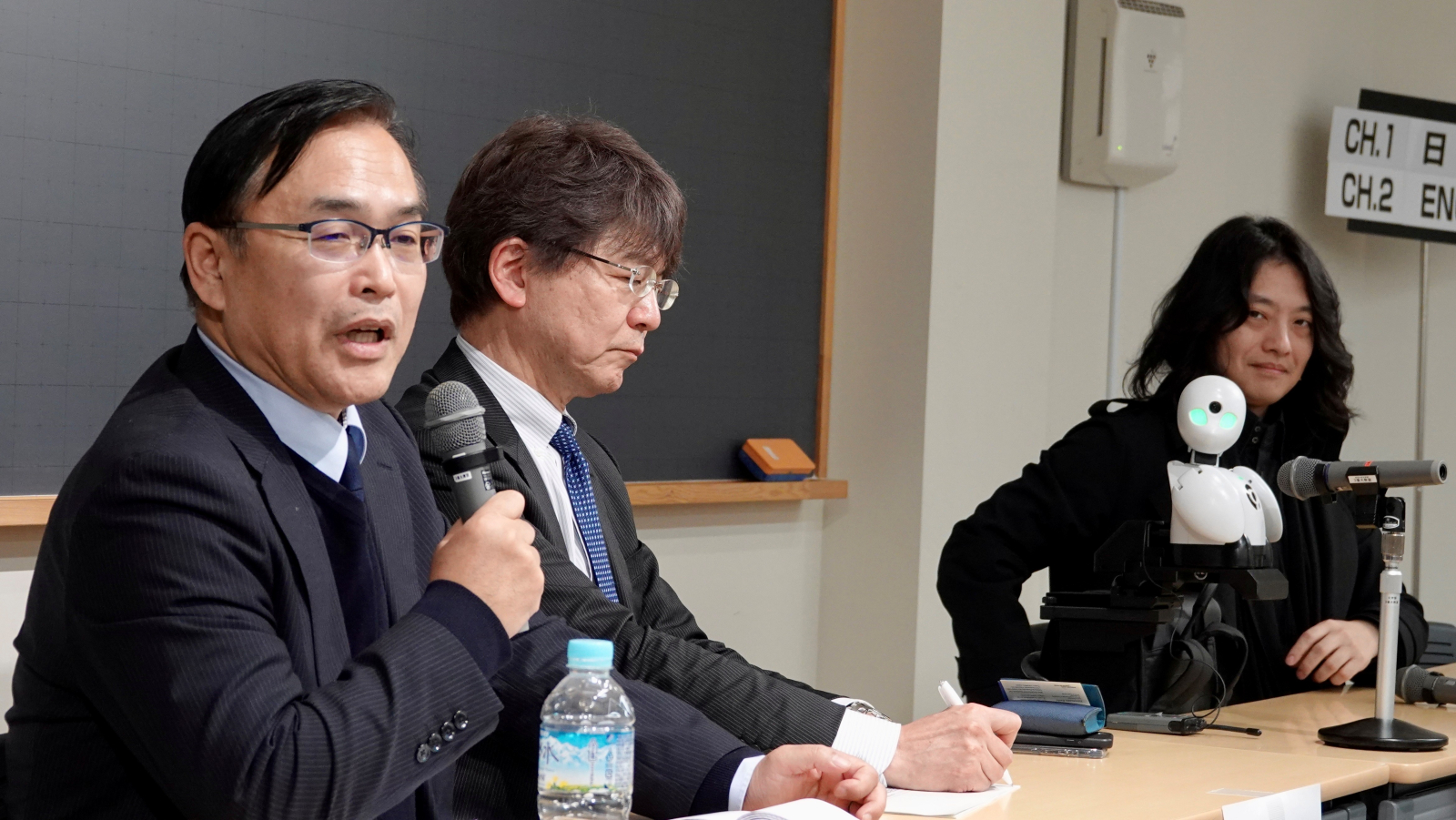
The Kyoto Institute of Philosophy (KIP) co-organized the symposium “Philosophy and Technology on the Horizon of Hope” on February 2 with the University of Tokyo’s P4NEXT project at the Institute for Advanced Studies on Asia and its Faculty of Letters and Graduate School of Humanities and Sociology. How should philosophy understand advanced technologies such as AI, and what kind of philosophy do these technologies require? Scholars from Japan and abroad exchanged views from a variety of perspectives, with around 50 people in the audience listened intently in a classroom on the University of Tokyo’s Hongo Campus.
Details
The symposium was organized to build on the rich discussions at the first Kyoto Conference held last September—“Toward the Realization of a ‘Multilayered Society of Values’”—while incorporating perspectives from Asia and Africa.
Opening remarks were delivered on behalf of the organizers by Professor Takahiro Nakajima and Professor Noburu Notomi of the University of Tokyo, together with Professor Yasuo Deguchi of Kyoto University, who serves as Co-Chairperson of KIP. This was followed by a lecture by Professor Yuk Hui of Erasmus University Rotterdam, who spoke about the relationship between rapidly evolving AI and human beings.
Professor Hui emphasized that “Human freedom is realized not just by escaping the machine or destroying it, but by giving the machine its ‘proper place’.” He explained that this “proper place” involves re-evaluating automation and recognizing its limits, and argued that in the age of AI humanity should explore “a new relationship with technology.”
Offering a lecture from an African perspective was Wakanyi Hoffman, Lead Researcher at the Inclusive AI Lab at Utrecht University, who participated as a guest speaker. Originally from Kenya, Hoffman conducts research on incorporating the African philosophical idea of Ubuntu into AI systems and also appeared as a panelist at the Kyoto Conference.
In her talk, she noted that “in Africa, there’s a big fear that we have entered a new era of data colonialism,” adding that there is a concern that “humanity’s future will be taken over by AI technology developed by third parties, mostly in America, and spoken in languages that are neither European nor African. And this fear is something that is probably being discussed here in Japan.” At the same time, she also emphasized that there is no need to fall into pessimism, stating that humanity’s hope lies “in the value of each culture,” and introduced the philosophy of Ubuntu, rooted in the idea that “I am because you are.”
The symposium also featured lectures by Professor Kim Hang of Yonsei University (South Korea), Professor Tetsuya Kono of Rikkyo University, Professor Tatsuhiko Inatani of Kyoto University, Ory Yoshifuji, Director of OryLab Inc., known for developing the avatar robot “OriHime,” joined by Masato Nagahiro, and Takashi Yoshimura, Director of the Keidanren Policy Research Institute.
Living with the rare disease spinal muscular atrophy (SMA), which gradually weakens muscles throughout the body, Nagahiro appeared via OriHime and remarked: “Becoming bedridden does not mean the end of one’s life. Even now, it is possible to go where you wish to go, to meet the people you wish to meet, and to help create the future. I do not believe that a person’s life is determined solely by whether they can move their body. If there are vehicles—like OriHime—that allow the mind to remain free, I believe people can still discover many joys in living.”
Others
NTT Chairman Sawada appears on radio to discuss the Inaugural Kyoto Conference and KIP’s founding
2026.02.24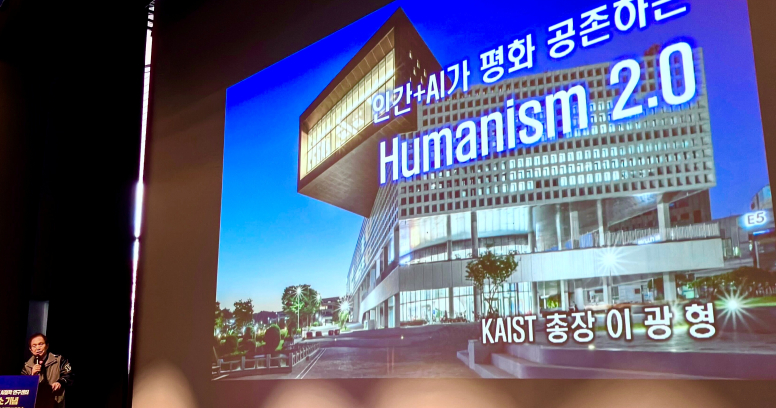
Prof. Deguchi and Dr. Takagi speak at symposium celebrating establishment of KAIST AI philosophy research center
2026.02.22