Navigating a Multilayered Society: Kyoto Institute of Philosophy and Kyoto University host inaugural seminar
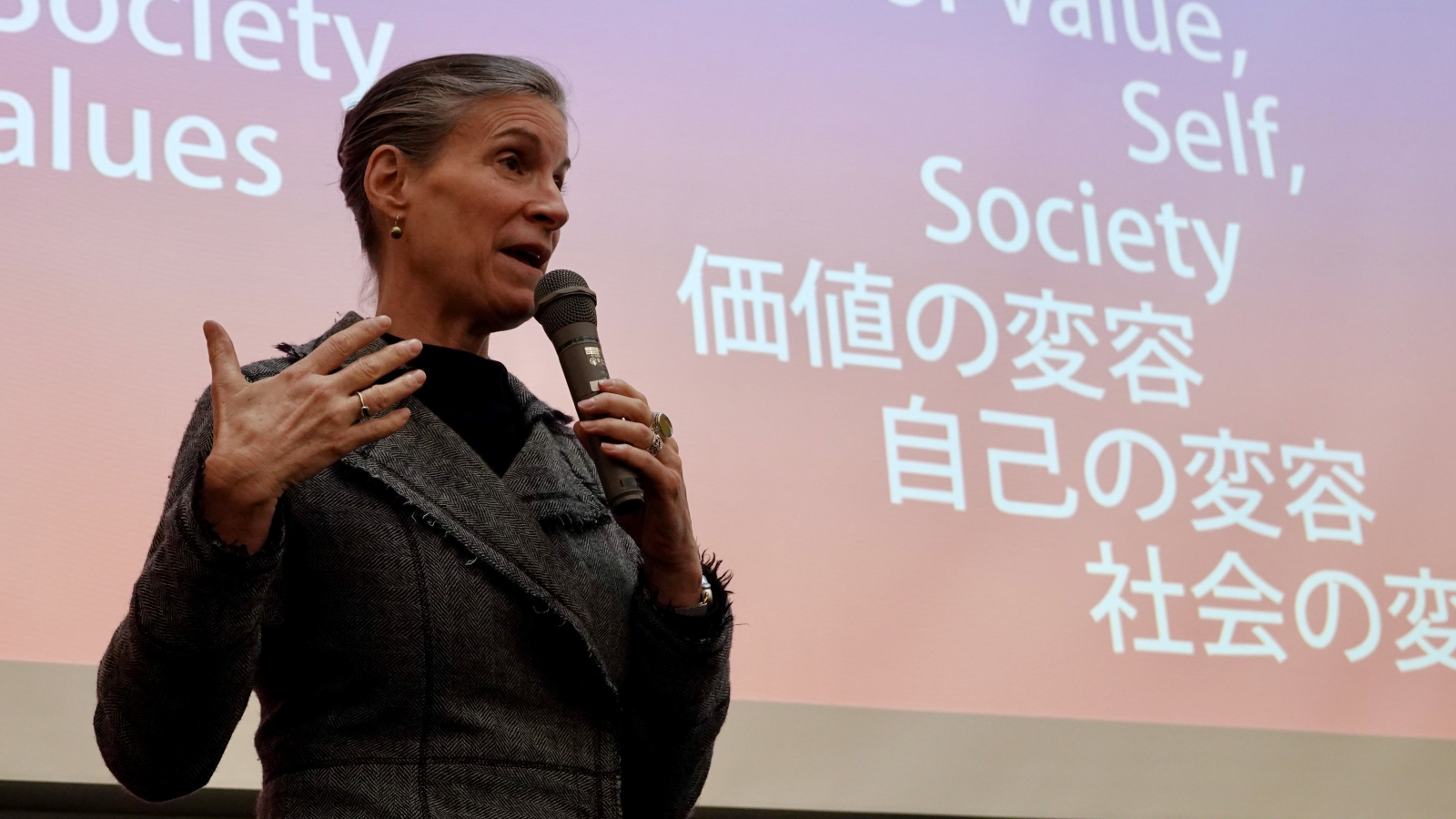
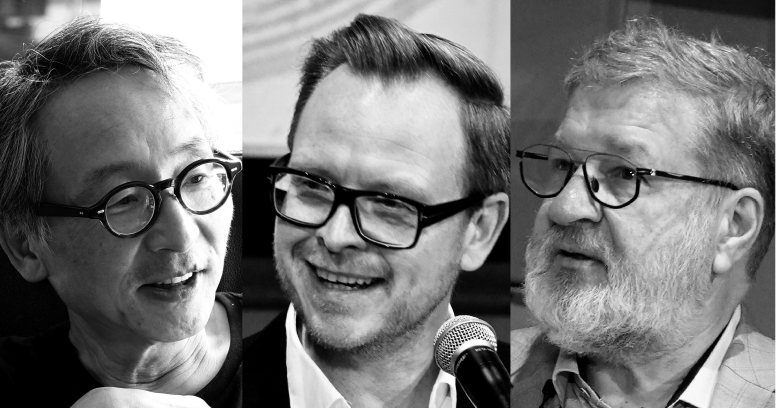
On November 17, to mark the signing of the comprehensive partnership agreement between both institutions, the Kyoto Institute of Philosophy and Kyoto University organized a commemorative seminar titled “Humanities in a Multilayered Society of Values: Transformations of Value, Self, and Society”. The event took place at the Yamauchi Hall in Shiran Kaikan on the Kyoto University campus and brought together about 200 participants in total, both in person and online. Speakers included the co-chairperson of the Kyoto Institute of Philosophy, Professor Yasuo Deguchi of Kyoto University, and Professor L. A. Paul of Yale University, who also participated as a panelist at the first Kyoto Conference in September.
Details
Earlier, on June 23 of this year, the Kyoto Institute of Philosophy concluded a comprehensive partnership agreement with Kyoto University with the shared aim of helping to establish Kyoto as a global hub for intellectual exchange and value creation. The agreement is designed to reinforce the Institute’s effort to build an international movement and the University’s initiatives to develop a global agenda. In his lecture, Professor Deguchi outlined concrete plans for collaboration under this framework. Reaffirming the Institute’s plan to issue a “Kyoto Declaration” at the second Kyoto Conference, scheduled for 2027, he highlighted several key initiatives:
1.Holding discussions with Kyoto University researchers on the content of the Kyoto Declaration;
2.Connecting researchers around the world with early-career researchers at Kyoto University; and
3.Strengthening collaboration among industry, government, academia, and civil society.
Professor Deguchi also explained the core idea of a “Multilayered Society of Values”, which serves as the guiding vision for the Kyoto Institute of Philosophy. He suggested that, “for both individuals and societies, different value systems—including those that may sometimes be opposed or even mutually contradictory—do not simply blend into a neutral compromise but instead coexist side by side in multiple layers,” and emphasized that we should work toward “a society that actively acknowledges this reality.”
Professor Deguchi then turned his attention to the ABC Model, which the Institute had introduced earlier at the Kyoto Conference. This model captures the mechanisms driving many contemporary challenges in terms of two dynamics—division and transformation—and proposes a way to move beyond them. According to him, the model encourages us to dive down to the core (Core = C) questions (What is humanity? What is society? What are values?) and then to build bridges (Bridge = B) that connect this core level of reflection to concrete actions (Action = A). “By moving back and forth between A and C,” he said, “we can work toward realizing a Multilayered Society of Values.” He encouraged participants to cooperate in pursuing this goal.
Professor Paul devoted roughly an hour to her main research topic, “transformative experience.” A transformative experience, she explained, is one that produces both epistemic transformation—an experience such that you can only truly know what it is like by actually undergoing it—and personal transformation, in which the experience changes you deeply and reshapes your core values and identity. During her lecture, she also discussed Professor Deguchi’s proposal of a “WE-turn.” “We’re living in transformative times,” she observed, “and we need to understand the distinctive challenges that such change brings.” She then said that by bringing in Professor Deguchi’s WE-turn, “we need to build a collective approach to transformation, respecting the different ways that different WE’s, different value systems, are a part of the process.”
The commemorative seminar also featured a lecture by Professor Tatsuhiko Inatani of Kyoto University, titled “Legal Engineering: On the Integration of Law and Technology through AI.” Following the seminar, a research roundtable was held. Dr Samuel Mortimer, a research fellow at the Kyoto Institute of Philosophy, Intesa Sanpaolo Research Fellow at the University of Oxford, and specially appointed lecturer at Kyoto University’s Graduate School of Management, gave a presentation that set the stage for an active exchange of views with researchers in visual science, cognitive science, landscape studies, and neuroscience.
Others

New paper by Dr. Samuel Mortimer published in Mind
2026.01.01
Collaboration with Portuguese academic institutions: Building a foundation for network development — Prof. Deguchi, Prof. Gabriel visit three cities
2025.12.23