Report session about Kyoto Conference outcomes held in Tokyo; 35 participants engage in lively exchange of views
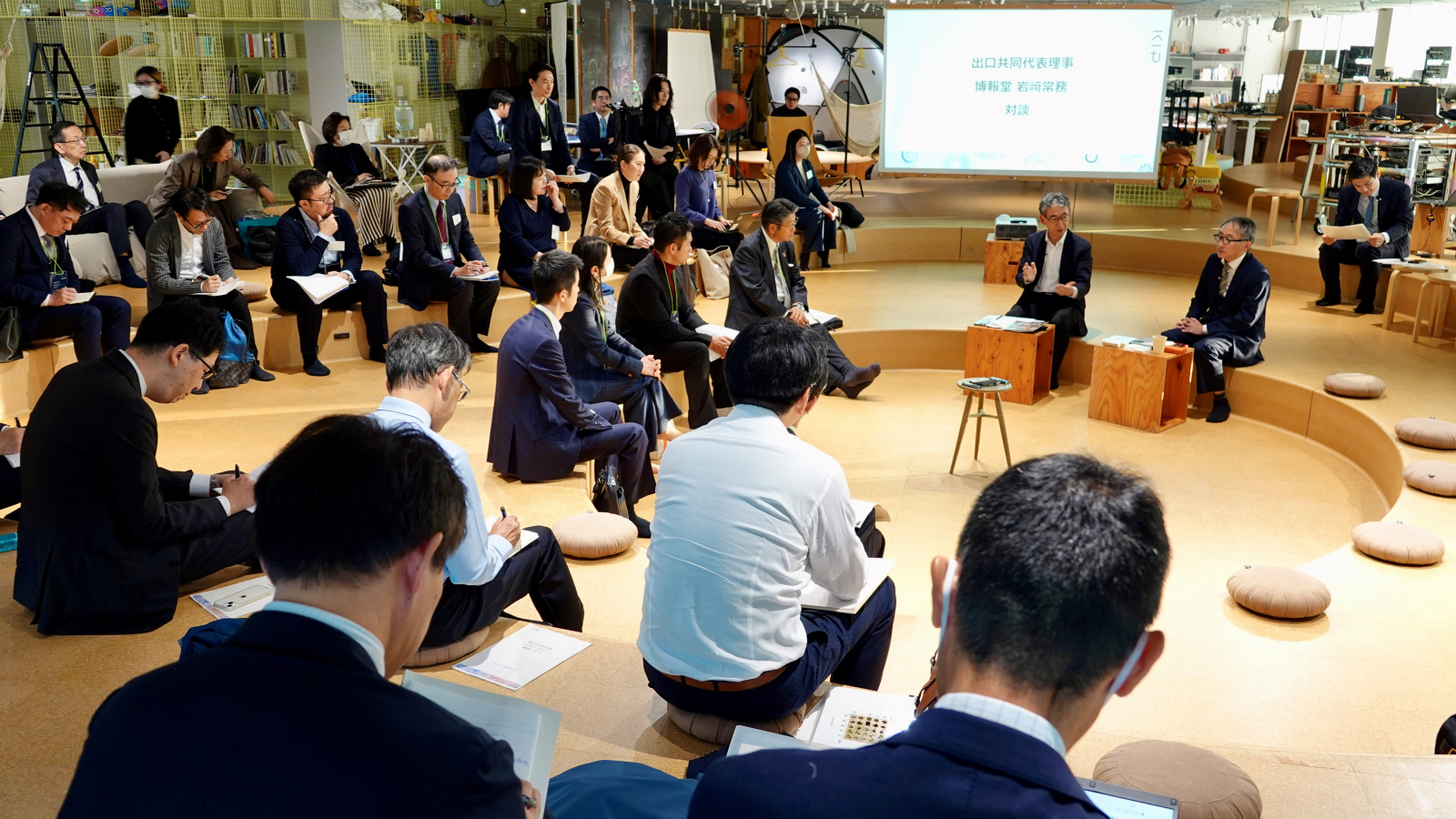
On December 16 last year, the Kyoto Institute of Philosophy held a report session reflecting on the first Kyoto Conference at Hakuhodo Inc.’s UNIVERSITY of CREATIVITY in Akasaka, Tokyo. The program featured a lecture by Professor Yasuo Deguchi of Kyoto University, who serves as Co-chairperson of the Institute, followed by a dialogue between Professor Deguchi and Taku Iwasaki, Senior Corporate Officer of Hakuhodo. In the latter half of the session, a lively exchange of views unfolded with participants.
Details
The event was organized primarily for corporate supporting members of the Institute, as well as for company representatives who had been invited to the Kyoto Conference but were unable to attend due to various circumstances. The venue, UNIVERSITY of CREATIVITY, is a creative space on the 23rd floor of Hakuhodo’s headquarters where the company’s creators work. The 35 participants removed their shoes before stepping onto the natural warmth of the wooden floor and sat in a circle.
Following a report on the content of the Kyoto Conference, Professor Deguchi delivered a lecture for about 20 minutes. He spoke about the direction of a society with multilayered values, in which diverse values coexist while embracing contradictions, and remarked, “Is it easy to achieve? Of course it isn’t. But if we give up or fall into despair, there is no future—only a gray present stretching on. We have to do something. That is one of the core ideas of the Kyoto Institute of Philosophy, and for that, philosophy matters: expressing in words what one has come to understand at a deep, personal level.”
In his dialogue with Mr. Iwasaki, Professor Deguchi revisited themes that had been central to the Kyoto Conference, such as “the relationship between AI and human beings,” and expressed his enthusiasm for the second Kyoto Conference—at which a Kyoto Declaration is planned to be issued—saying, “We have to travel around the world. We need to engage in discussions with many different people and incorporate a diversity of voices into our Kyoto Declaration.”
The subsequent session for exchanging views with participants was designed, like the roundtables that had been well received at the Kyoto Conference, to allow everyone to speak freely. For nearly an hour, hands continued to rise without pause, making for an exceptionally lively discussion.
One participant referred to Professor Deguchi’s WE-turn philosophy, which returns to the perspective of recognizing our fundamental incapability—the basic fact that nothing can be accomplished alone—and of seeing ourselves as part of a collective “WE.” From the standpoint of corporate management, the participant observed, “People are increasingly asking whether they can grow within their company, whether their own well-being can be enhanced, and whether they are contributing to solving social issues. Without that, employees are no longer able to feel a sense of happiness. In that sense, how to realize the WE-turn is the key.” Another participant offered a question that felt almost like a personal concern, asking, “Why do the core values or purpose statements that companies put forward so often end up sounding superficial?” Throughout, the dialogue continued in a warm and relaxed atmosphere.
The Institute is considering holding a range of events in Tokyo in the future for companies and organizations that are interested in its initiatives.
Others

Announcing the Kyoto–Oxford Symposium on Self, Identity, and Value Plurality
2026.03.19
‘Horizon of hope’ guided by philosophy: KIP and University of Tokyo hold symposium to discuss human and technology
2026.03.12