Humans and AI as Members of Same ‘WE’ Community: KIP Co-Chairperson
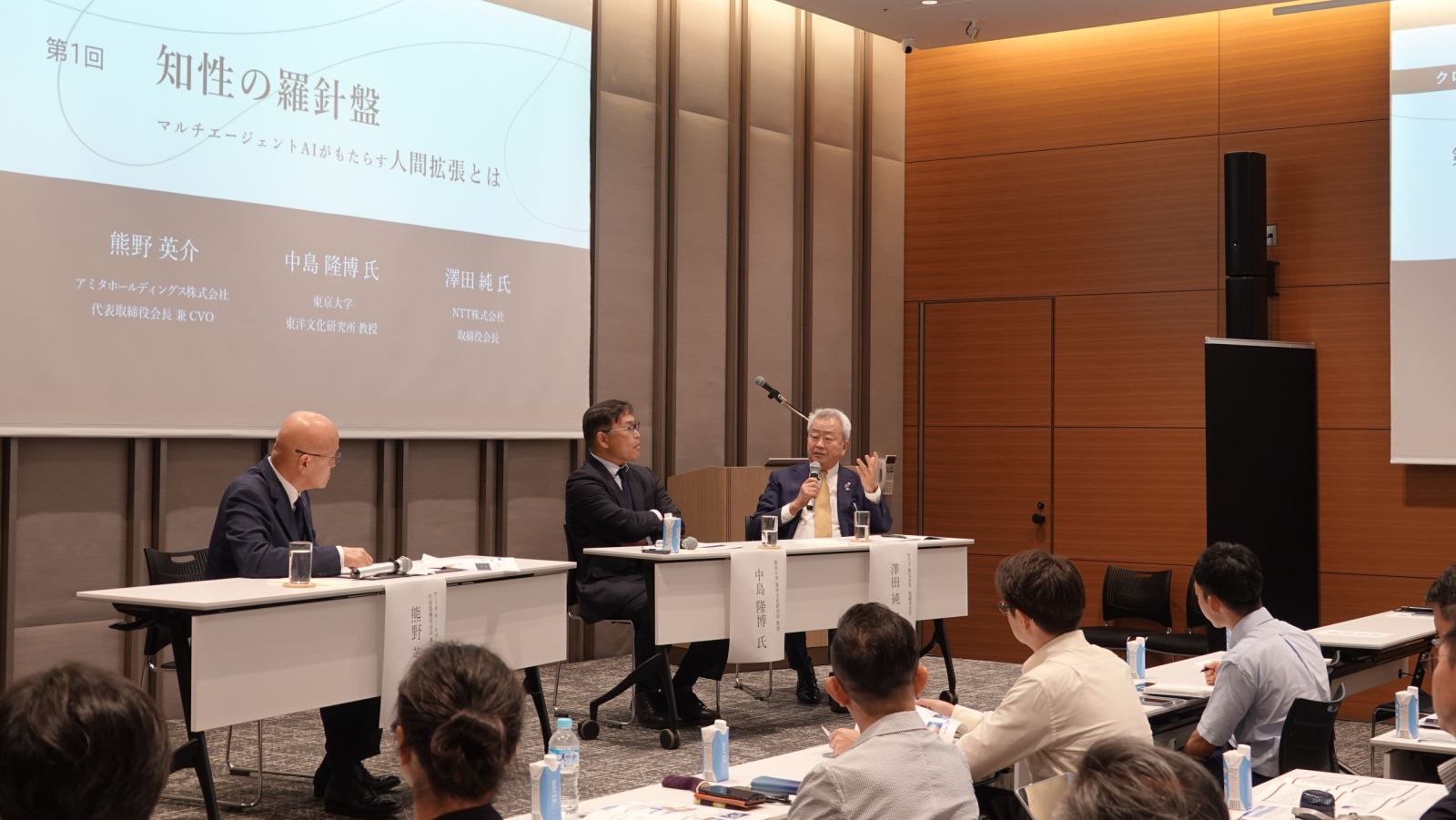
AMITA Holdings Co., Ltd., a Kyoto-based social design company engaged in resource recycling and related businesses, held the first session of its Compass Forum 2026, a series exploring the future of management in the age of AI, on July 28 in Yaesu, Tokyo. Could AI be reconceived not as a tool subordinate to human beings, but as part of the “WE” that shapes society together? Jun Sawada, Executive Chairman of NTT and Co-Chairperson of the Kyoto Institute of Philosophy (KIP), spoke at the event, emphasizing the need to think philosophically about management, science and technology, and AI.
Details
Under the theme “The Compass of Intelligence: Human Augmentation through Multi-Agent AI,” Professor Takahiro Nakajima of the Institute for Advanced Studies on Asia at the University of Tokyo and Sawada gave presentations, followed by a discussion with Eisuke Kumano, Chairman and Chief Visionary Officer (CVO) of AMITA Holdings. Approximately 100 corporate executives and other participants attended the event, which also featured a lively question-and-answer session.
In his talk, Sawada addressed the gap in perspective that can arise between the front lines of a company and its headquarters. Headquarters tend toward abstractive concepts, while those on the front lines tend to focus on concrete realities. What is needed, he argued, is not to choose one over the other: “Those on the front lines also need an abstract perspective, while headquarters need a concrete understanding.” Management, he suggested, is a “spiral movement” that moves repeatedly between the concrete realities of the front line and abstraction.
Sawada also discussed the strategy of “selection and concentration” long pursued by Japanese companies, arguing that this approach alone will ultimately make a company smaller. He stressed the importance of combining it with the opposite perspective of “selecting and expanding.”
He then highlighted the limitations of thinking solely in terms of “what exists.” In his view, it is not enough to simply ask, “What should we do with what already exists?” We must also envision possibilities beyond ourselves and things that “do not yet exist” simply because we have not yet experienced them.
Sawada also shared his vision for building a science and technology-oriented nation. He argued that Japan needs to shift toward an “investment-led economy” in which companies take the initiative to increase investment in R&D, capital equipment, and human resources. Science and technology alone, however, cannot transform society. Their application in industry and the needs of society are also essential, while thought and philosophy provide the foundation for the whole. He stressed the importance of viewing the three domains of “science and technology,” “industry and society,” and “thought and philosophy” as an integrated whole and strengthening the links between them.
Turning to what technology brings to humanity, Sawada drew on the myth of Prometheus. Technology can liberate humankind, but it can also lead to catastrophe. For human beings to live together, he explained, they need not only technology but also restraint and justice. Rather than viewing technology as determining society, or society as determining technology, he presented a social constructionist perspective in which the two shape one another.
This concern was also one of the factors behind the establishment of KIP. NTT’s next-generation information and communications initiative, IOWN (Innovative Optical and Wireless Network), aims to expand the use of optical technology to data centers, servers, and even semiconductor chips, with the potential to fundamentally reshape society’s information infrastructure. Sawada recalled explaining the concept to Professor Yasuo Deguchi of Kyoto University, who responded that if it were to become a new form of social infrastructure, it would also require a new philosophy. Sawada said this exchange helped lead to the establishment of KIP. He explained that KIP seeks to foster an ongoing dialogue between philosophy and industry. It also provides a forum for people from different countries and fields to reconsider the values and ideas about humanity needed to bring new technologies into society.
In industry, people often speak of the need to change mindsets, but slogans alone do not bring about change. Sawada argued that we need to reconsider the conceptions of humanity and values that lie beneath our mindsets. Rather than viewing AI merely as a tool subordinate to humans, he suggested that we might see ourselves and AI as members of the same community of “WE.”
In a discussion between Sawada, Professor Nakajima, and Kumano, they addressed the question about whether AI could become something that thinks together with human beings. Sawada explained that today’s AI draws together vast amounts of knowledge and generalizes from them, while at the same time being adjusted to remain within boundaries that humans consider acceptable. If an individual user seeks only answers that suit their own preferences, he warned, AI could become the “ultimate echo chamber.”
Sawada therefore proposed going beyond simply placing a single AI alongside a human being. He suggested connecting multiple AIs and allowing them to check one another, effectively creating an “Internet of AI.” AI itself, he noted, can also serve as a check on AI. By creating a structure in which multiple AIs mutually examine one another while coexisting with humans, he argued, AI could once again be brought into the “WE.”
Professor Nakajima argued that human beings are embodied beings who share the world with others and are transformed through their interactions and relationships. Although AI is not itself an agent of “Human Co-becoming,” in the sense of becoming human together with others, he suggested that it could become a companion that thinks with us by participating in shared processes involving humans and their environment.
During the question-and-answer session, one participant asked how companies could foster organizational strength and pride in the company while continuing to respect individuals.
Sawada responded by introducing the idea of “Self-as-WE.” We should value ourselves as individuals while at the same time valuing the whole, he explained. Individuals should not simply be expected to preserve a company’s culture and the company itself; the company, in turn, must protect its people and support their self-realization. Employees help the company thrive, while the company help the employees themselves thrive. Sawada suggested that when this reciprocal relationship is made clear, a sense of attachment to and pride in the company can emerge more naturally.
Another participant asked how people can mutually recognize values that cannot easily be quantified or clearly identified. Sawada shared three principles that he has kept in mind when leading organizations: rather than trying directly to change emotions, change the way one thinks and sees things; rather than trying to change the other person, consider how one can change oneself; and rather than remaining trapped by past failures, devote one’s energy to changing tomorrow.
Rather than commenting from the outside, one should engage directly with others and take the initiative oneself. Sawada argued that a way forward in recognizing values that are difficult to quantify lies in this kind of practice: not placing responsibility solely on others but becoming personally involved in the relationship.
In closing, Kumano emphasized the importance of not allowing thought to end with abstract discussion, but of entering into relationships, creating spaces for engagement, and putting ideas into practice through business. For business leaders, he said, such an approach will become increasingly important.
Others
Japan Business Federation Highlights Importance of Soft Power in Document to Prime Minister
2026.09.01
Kyoto Institute of Philosophy Exchanges Views on ‘Kyoto Declaration’ with Prof. Edward Freeman
2026.07.24