Participants from Different Sectors Discuss WE-turn, Living with AI in Mexico City
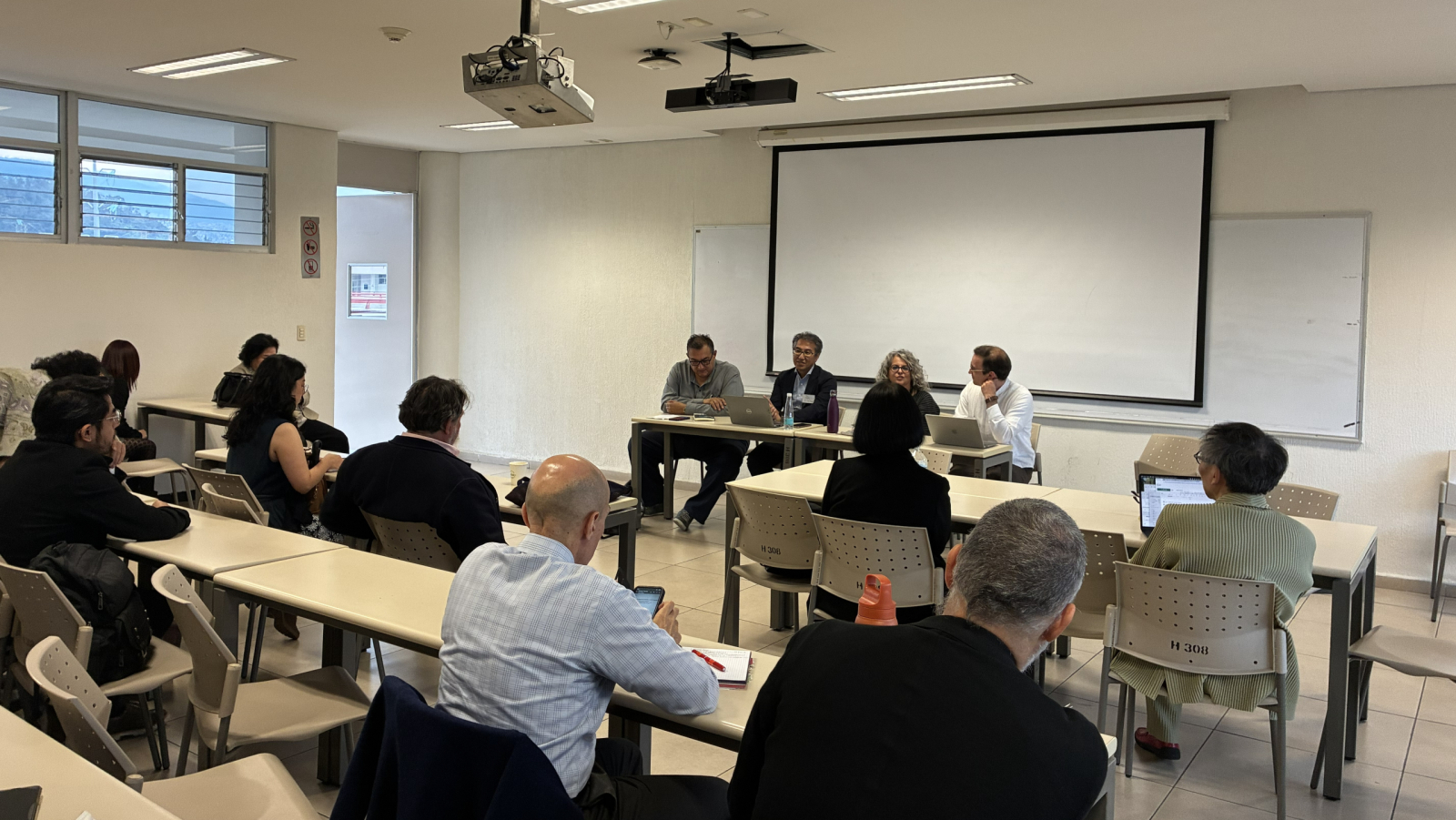
On September 14, 2026, the Kyoto Institute of Philosophy (KIP) held an international symposium at the Universidad Nacional Autónoma de México (UNAM) in Mexico City, co-organized with UNAM’s Graduate Program in Philosophy. Lectures were delivered by Professor Yasuo Deguchi of Kyoto University, Co-Chairperson of KIP, and Professor Markus Gabriel of the University of Bonn, KIP’s Senior Global Advisor. Participants from academia, business, education, and the arts came together to discuss values and the shape of society in the age of AI.
Details
The symposium was conceived as an opportunity to deepen dialogue with researchers and practitioners across Latin America. More than 50 people attended, primarily UNAM faculty members and graduate students specializing in philosophy. Ambassador Kozo Honsei of Japan to Mexico opened the symposium with welcoming remarks.
The program began with lectures by Professors Deguchi and Gabriel. Professor Deguchi spoke about the WE-turn, an approach he advocates. He presented the image of the "existential conveyor belt" that carries human beings toward an inevitable end, and reconsidered existence from the perspective of WE. In this view, the conveyor belt is "not 'my conveyor' but 'our conveyor,'" and "it is not 'I exist,' but 'we exist.'"
Professor Gabriel, who delivered his lecture in Spanish, discussed the limits of the scientific worldview, stating that "metaphysics cannot be outsourced to science." Drawing on his ontology of fields of sense, which holds that "to exist is to appear in a field of sense," he argued that reality cannot be gathered into a single whole but takes a plurality of forms.
After a lunch hosted by the UNAM Graduate Program in Philosophy, the afternoon began with an introduction to KIP’s activities, followed by two discussion sessions. The first session addressed “From Individual Choice to Shared Responsibility: Public Life, Institutions, and the WE-turn,” while the second explored “Living with AI: Technology, Culture, and the Futures of Human Experience.”
The discussions adopted the same roundtable format used at KIP’s inaugural Kyoto Conference. The sessions began with conversations among speakers from different sectors, including academia (primarily UNAM), business, primary and secondary education, and the arts and culture. Participants then discussed the themes in smaller groups and shared their insights with everyone. Instead of simply listening to speakers, all participants had the opportunity to bring their own experience and expertise to the discussion, listen to one another, and reflect more deeply on the issues.
Although this format appeared to be new to many participants from Mexico, the warm and informal atmosphere of gathering around the same table encouraged candid exchanges across disciplines and professional backgrounds. Afterward, participants expressed appreciation for the opportunity to engage directly with people from other fields and to gain fresh perspectives that could inform their own research and practice.
The symposium embodied KIP’s aim of exploring philosophical questions together across disciplinary and professional boundaries. Throughout the day, participants deepened their understanding of one another’s perspectives and laid the groundwork for future exchange.
Others
KIP to Co-host Cross-Sector Symposium on Human Intelligence in the AI Era and Japan’s Potential at Waseda University
2026.10.30
New Paper by Dr. Samuel Mortimer Explores How Communities Cultivate Authenticity—and Why It Matters for Leadership
2026.10.22