Rethinking the self through value plurality: Kyoto–Oxford symposium draws around 100 participants
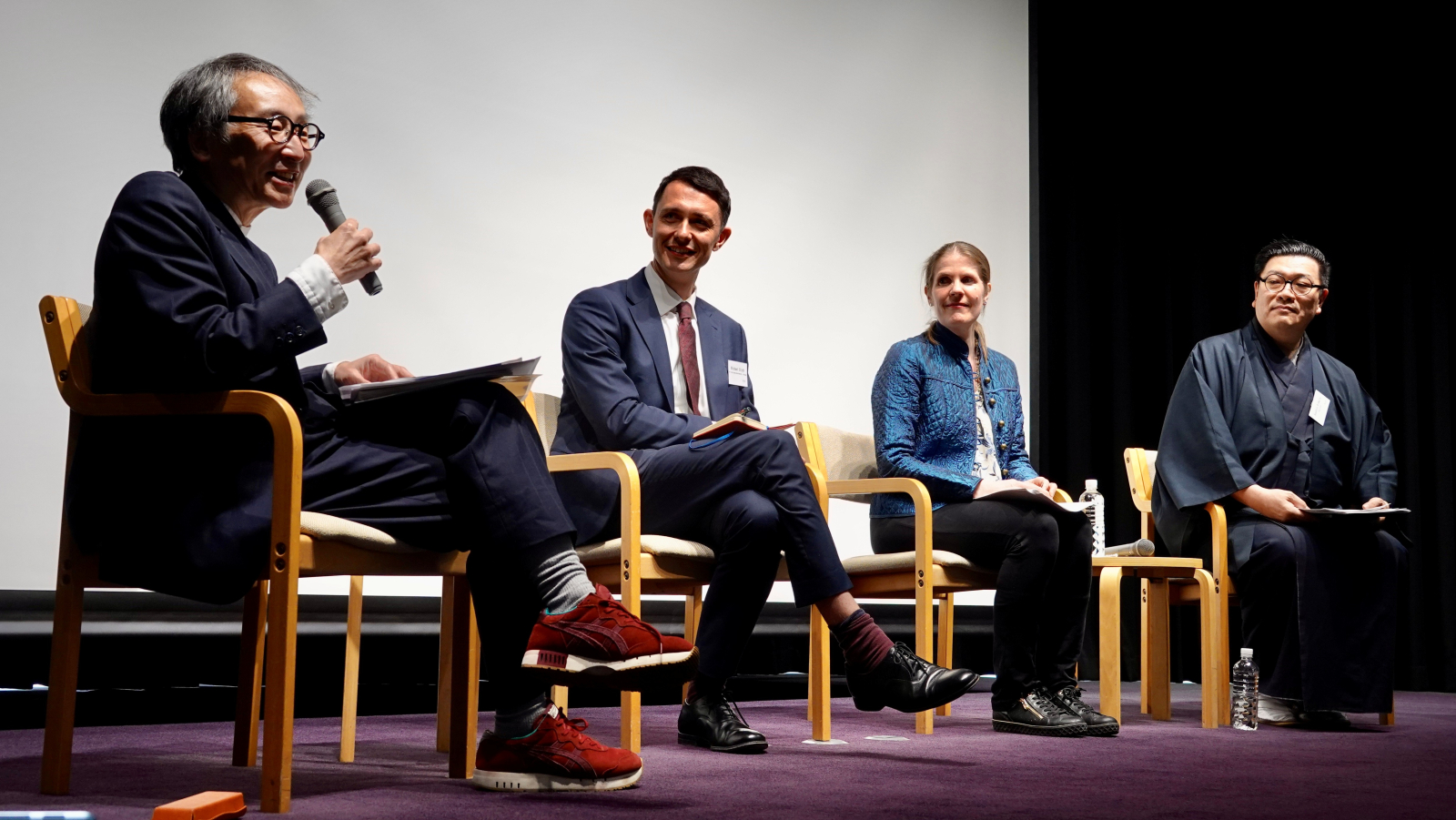
On 14 and 15 April, the Kyoto Institute of Philosophy (KIP) held the symposium “Self, Identity, and Value Plurality” at Inamori Hall in Kyoto University’s Shiran Kaikan. Around 100 scholars, business representatives, and other participants from Japan and abroad took part, engaging with diverse perspectives and reflecting more deeply on the symposium’s themes.
Details
The symposium was co-hosted by KIP, Kyoto University, and the Oxford University Centre for Corporate Reputation (CCR) at Saïd Business School, University of Oxford. Speakers included Professor Yasuo Deguchi of Kyoto University, Co-Chairperson of KIP; Professor Alan Morrison of the University of Oxford; and Rupert Younger, Director of CCR. KIP has been strengthening its relationship with the University of Oxford. In May 2025, for example, KIP collaborated with CCR on a symposium held at the University of Oxford, with members of KIP travelling to the UK to participate.
Opening the symposium, Professor Wiebke Denecke of the Massachusetts Institute of Technology (MIT) drew attention to KIP’s initiative to build a global network towards the realisation of a Multilayered Society of Values. She observed that ‘one of the very unique things about KIP is to convene people of so many different backgrounds, tribes, ways of thinking, ways of working’, adding that such trans-sectoral dialogue is especially valuable. In her lecture, Professor Denecke called for a global metaphilosophy of the self: an inquiry into the assumptions underlying philosophy itself by reflecting on how different philosophical traditions have developed distinct models of the self. Such an approach, she suggested, could help open the way towards a new paradigm of value plurality.
Professor Morrison then posed the question of why people care so deeply about their reputation, noting that social science does not yet offer a fully satisfactory account of this concern. While acknowledging that reputation can function as a useful asset, he pointed out that it is also bound up with selfhood. To elucidate this, he introduced the idea of a “vapour trail”: the traces left by one’s past actions. Reputation, he suggested, is an interpretation of that trail, and selfhood is shaped by how both we ourselves and others interpret it.
Two trans-sectoral panel discussions were also held to connect academic debate with social practice. Building on the dialogue across professional practice, culture, and scholarship developed at the First Kyoto Conference, the sessions examined from multiple angles how value plurality surfaces in social practice, including from the perspectives of industry, diplomacy, and culture.
The first panel featured Christine Edman (Outside Director of Seven & i Holdings Co., Ltd.) Leo Lewis (Tokyo Bureau Chief of the Financial Times), and Keisuke Kumagai (Partner at Deloitte Tohmatsu). Moderated by Rupert Younger, Director of CCR, the discussion considered how corporate purpose has evolved since the 1990s, when the pursuit of shareholder value was widely regarded as the raison d’être of the firm. Younger observed that, particularly since the 2008 financial crisis, there has been growing recognition that companies are social entities with responsibilities to a wide range of stakeholders. Drawing on their respective experience in executive leadership, senior consulting, and journalism, the panellists discussed how value plurality is encountered in the realities of business.
The second panel brought together Michael Blyth (British Consul-General in Osaka), Soshin Kimura (Grand Tea Master and Head of Hoshinkai), and Professor Denecke, with Professor Deguchi serving as moderator. The panel discussed the roles that diplomacy and culture can play in the pursuit of collective flourishing. Consul-General Blyth emphasised that diplomacy should not be understood as the art of ‘letting someone else have your way,’ but rather as the work of building bridges between different cultures. Referring to this bridge-building role, Kimura explained the essence of wabi. Professor Denecke introduced the MIT Comparative Global Humanities Initiative, which she leads, and explored how literature may contribute to the cultivation of diplomatic intelligence.
On the second day, 15 April, the symposium continued with a lecture by Professor Noburu Notomi of the University of Tokyo and a joint presentation by Professor Joseph Schear of the University of Oxford and Professor Sophie Archer of Cardiff University, as well as a panel discussion featuring Dr Dongwoo Kim, Director of the KAIST AI Philosophy Research Center, among others.
Others