Dialogue: Professor Yasuo Deguchi (Kyoto University) × Ory Yoshifuji (CEO, Ory Laboratory) — Part 1 —: The café with OriHime where incapability and ‘We’ coexist
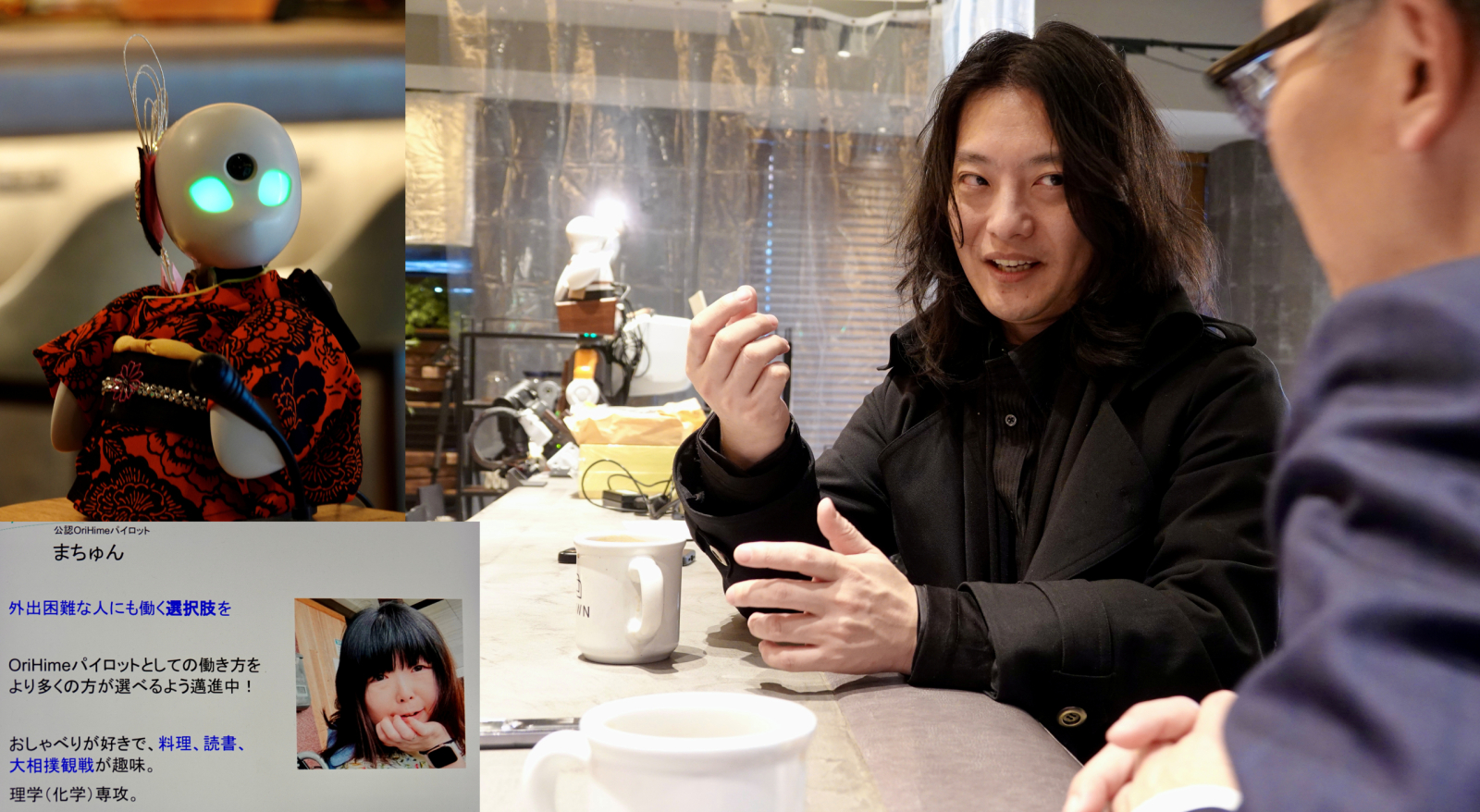
At the first Kyoto Conference held last September, people living with illnesses or disabilities also took part in discussions on topics such as “the relationship between humans and technology” and “the value of work.” The discussions took place through OriHime, a remotely operated avatar robot. In order to further explore themes that could not be fully discussed at the conference, Yasuo Deguchi, Co-chairperson of KIP and Professor at Kyoto University, visited the Avatar Robot Café DAWN ver.β in Nihonbashi, Tokyo, to speak with Ory Yoshifuji, Director of Ory Laboratory and developer of OriHime.
Details
Creating the “Value” of Work for People with Mobility Difficulties
Deguchi: Thank you very much for coming all the way to Kyoto in the summer heat for the Kyoto Conference. At KIP, what you and your colleagues at Ory Laboratory are doing deeply resonates with us. After the conference, I heard that Markus Gabriel, Senior Global Advisor of KIP, and Toshikazu Yamaguchi, President of The Yomiuri Shimbun Holdings and also a director of KIP, visited this avatar robot café and interacted with the pilots here. As I will explain later, your creation, OriHime provides an excellent illustration of what I call “fundamental incapability.” This is my second visit to the café, and it is always full of energy.
Yoshifuji: At this café, people who are described as having “mobility difficulties” — due to illness, disability, family circumstances, and so forth — work as OriHime pilots. About one hundred people work here on rotating shifts. Some OriHime robots handle reception for visitors, some serve drinks and food, and others sit at tables and converse with customers. In that sense, this is a place where we research and implement new ways of working and the value of working for people with mobility difficulties. The café opened in June 2021, and thankfully we now welcome around sixty thousand visitors a year. Today, Machun, her nickname, who actually works here at the café, has also joined us through OriHime.
Machun: Nice to meet you. I live with multiple sclerosis, which is a rare disease, and I normally use a wheelchair in my daily life. In 2022, I became bedridden for several months after contracting COVID-19. I used to work in a different job, but the aftereffects of COVID became too severe, and I had to quit. Suddenly becoming unemployed made me start wondering, “What is my value?” To be honest, there were periods when I would simply stare at the ceiling and cry. Then, in June 2024, I came across a recruitment notice for pilots at this café. I applied, and four months later, in October, I started working here.
OriHime as a “Wheelchair for the Heart”
Deguchi: What have you learned through working here?
Machun: As Ory (Yoshifuji) says, “OriHime is a wheelchair that carries the heart.” Even though my physical body never leaves my home, I’m still able to “meet” the customers who come to the café through OriHime. I majored in chemistry when I was a student, so I often feel that OriHime serves as a kind of catalyst that connects people’s hearts.
Yoshifuji: According to a survey by the Ministry of Land, Infrastructure, Transport and Tourism, there are approximately thirty million people in Japan with mobility difficulties. In fact, I was once one of them myself. For three and a half years, from elementary school through junior high school, I was unable to attend school due to illness and stress, and I experienced profound loneliness. I was eventually able to return to school in my second year of junior high, and after entering a technical high school, I devoted myself to research and development related to electric wheelchairs. At that time, I began thinking, “I want to create a wheelchair for the heart.” That idea eventually became OriHime, and we later opened the avatar robot café as a place to research and experiment with expanding the role OriHime can play.
Deguchi: From a philosopher’s perspective, this café is truly fascinating. Things are happening here that go far beyond what philosophy has traditionally tried to explain. Rather than trying to fit them neatly into existing philosophical language and convincing ourselves that we understand them, what we philosophers should do is allow ourselves to be astonished. In other words, our existing sense of values and worldview have been expansively ruptured. If you heat a rice cake, it gradually swells until the surface breaks open, and the rice cake spills out from inside. I think this café is a place where people can have that kind of experience.
Yoshifuji: In today’s world, with online spaces and remote work becoming widespread, it is, at least in principle, possible for people with mobility difficulties to participate in society. But I wanted to create something more physical: an “avatar” through which others would recognize that “you are really there.” Not a substitute standing in for you, but rather the feeling that “you have another body.” OriHime was created with that idea in mind. I believe it connects with what Professor Deguchi describes as “embodiment.”
Deguchi: The key concepts in my philosophy are “the body” and “somatic (bodily) action.” Another key concept is “incapability.” I believe the essence of being human lies not in what we can do, but in what we cannot do. I call this “fundamental incapability.” Everyone carries it within themselves. And from there emerges the We. The We I speak of is a We grounded in incapability. Fundamentally speaking, human beings can do nothing alone. And yet, in our daily lives, we accomplish many things. For example, Machun is working here in this café. That is possible because everyone working together forms a We and supports one another, and because advances in technology expand what the We can do. In other words, both incapability and the We coexist within this café.
Others