Dialogue: Professor Yasuo Deguchi (Kyoto University) × Ory Yoshifuji (CEO, Ory Laboratory) — Part 3 — Making the café with OriHime a place where people can discuss their weaknesses

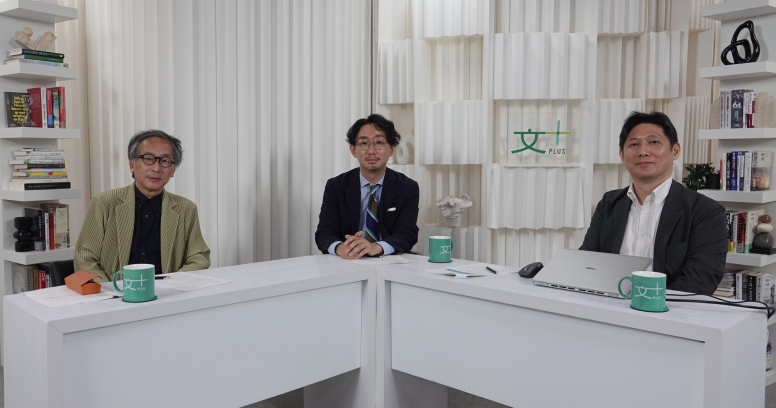
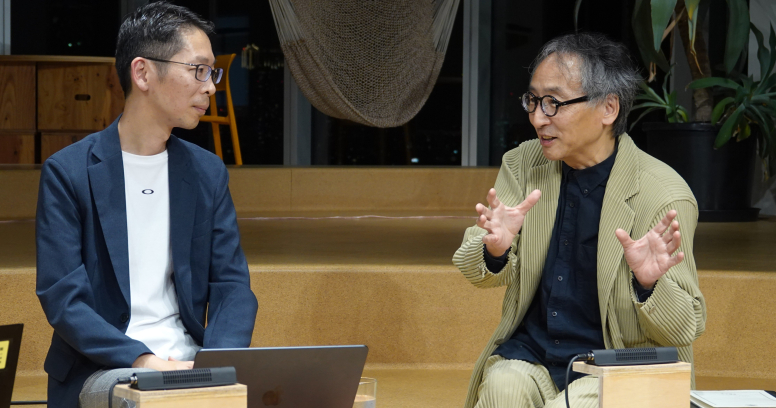
Professor Yasuo Deguchi, Co-chairperson of the Kyoto Institute of Philosophy and professor at Kyoto University, visited the Avatar Robot Cafe DAWN ver.β in Nihonbashi, Tokyo. There, he engaged in a dialogue with Ory Yoshifuji, Co-founder and CEO of Ory Laboratory, the developer of the "OriHime" avatar robot. This article is the last installment in a three-part series (Part 3 of 3).
Details
The Joy of Giving Form to Presence
Deguchi: Let me briefly reflect on the first Kyoto Conference last September. I believe the participation of OriHime was one of the highlights of the conference. You attended the conference with OriHime sitting on your shoulder, Mr. Yoshifuji. Masato Nagahiro remotely operated OriHime from his home in Tokyo. He lives with spinal muscular atrophy (SMA), a rare disease that gradually weakens muscles throughout the body. I understand that Mr. Nagahiro is able to operate OriHime through an eye-tracking sensor and also serves as your secretary. I have heard that the two of you share a relationship of extremely deep mutual trust, and that you call him “Masa.”
Yoshifuji: Yes. One thing that left a strong impression on me at the Kyoto Conference was that everyone, including Professor Deguchi, kept saying, “We’re so glad Masa was here.” Physically speaking, Masa was bedridden at his home in Tokyo, so in one sense it was only OriHime that attended the conference. But everyone truly felt that Masa himself was there. We also attended related events around Kyoto together. At one point, Kyoto Mayor Koji Matsui even invited Masa to come forward and say a few words. He also interacted with maiko geisha apprentices. That day, Masa began participating—or perhaps I should say, began being present—through OriHime around nine in the morning, and he finally logged off around eight at night. He spent eleven hours operating OriHime that day.
Deguchi: That sounds a little exploitative! (laughs)
Yoshifuji: If you think of it as labor, perhaps it does sound exploitative. (laughs) But I felt genuine joy in being able to create a state in which he could truly “be present” to that extent.
Deguchi: At the symposium “Philosophy and Technology on the Horizon of Hope,” which we co-hosted in February with the P4NEXT project at the Institute for Advanced Studies on Asia at the University of Tokyo and others, Masa also joined the stage through OriHime following your lecture. One thing I remember from your talk was your story about how bad you are at managing schedules and how you rely on Masa to help you.
Yoshifuji: Lately, I’ve been relying on Masa too much. I’ve realized I’m becoming less capable as a result. (laughs)
Deguchi: Forget schedule management—my entire daily life is overflowing with “incapability.” (laughs) I can only live my life to begin with because my family and secretaries support and care for me in so many ways. To look at it another way, we truly can do nothing alone. But I think it’s better to openly admit what we cannot do. Genuine relationships begin when people openly expose those weaknesses to one another. If we only interact like elite businesspeople who act as though they can do everything, we can’t develop real relationships, can we? Complaining means exposing one’s weaknesses and vulnerabilities. But it is more than simply licking each other’s wounds. The two of us stop by a little akachochin, a small Japanese-style pub marked by a red paper lantern, and vent about our weaknesses together. It is through exposing ourselves that the We emerges.
Take Off the Armor Around Your Heart
Yoshifuji: Complaints can sometimes become aggressive when directed toward third parties. Is there such a thing as a healthy way of expressing weakness?
Deguchi: I don’t mean aggressively criticizing other people. I mean saying, “I can’t do this.” Complaining about one’s own limitations. I think that is what it means to “take off the armor around your heart.”
Yoshifuji: That itself requires a certain kind of strength. Sitting in a little red lantern pub saying, “No, I can’t do this…” takes a fair amount of courage and self-awareness.
Deguchi: In fact, the counterpart to the vulnerability we’ve been discussing is resilience. Living beings are fragile and easily wounded. But they also possess the power to recover. Even when injured, they have the ability to heal themselves. Human beings are not perfect creatures, so our hearts constantly waver and falter. But we also possess the strength to recover from that. Vulnerability and resilience are inseparable from one another. That combination creates a kind of flexibility. Not the rigid strength of superalloy, but a flexible strength grounded in an honest acceptance of weakness itself. And since recovering alone is difficult, that too requires the We. Sitting together under a red paper lantern, sharing dishes like oden, a Japanese stew simmered in broth, and venting about our weaknesses together—that is also a way of recovering through the We.
Yoshifuji: Actually, I’ve always loved the folk group Kaguyahime, especially “Akachochin” (“Red Lantern”) by Kosetsu Minami.
Deguchi: Then perhaps this café is a kind of “Red Lantern Pub for the Reiwa Era.”
Yoshifuji: I love that expression! That’s such a wonderful phrase.
Deguchi: Come to think of it, the neon sign reading “Snack Bar OriHime” at the café’s bar counter gives off a wonderfully warm, highly nuanced shade of red.
Yoshifuji: When I imagine the future—or science fiction, perhaps—the image I always return to is the red lantern. Most depictions of the future are drenched in blue. To put it simply, it’s a world of blue LEDs. That world of black, white, and blue has been in style recently. But I want the future I imagine to be something different from that.
Deguchi: Philosophically speaking, what dishes served in little red lantern pubs—things like oden or braised pork belly—have in common is that you can “see time” in them. Take daikon in oden, for example. Before it is simmered, it is white and hard. But gradually the broth soaks in, it changes color, and it becomes soft. When you see a piece of daikon on a plate, stained with broth and looking tender, you can see time within it. Perhaps it would be wonderful for this café to serve food in which you can sense time itself.
Yoshifuji: Many of our customers come from overseas as well. It would be wonderful if they could enjoy Japanese food, including oden, here in this “Red Lantern Pub for the Reiwa Era.” Machun, next time let’s create an OriHime that can make oden and serve it here.
Machun: Absolutely. Definitely.
(End)
Others