Keidanren Refers to Kyoto Conference Initiative in Policy Proposal Toward ‘Science and Technology-Oriented Nation’
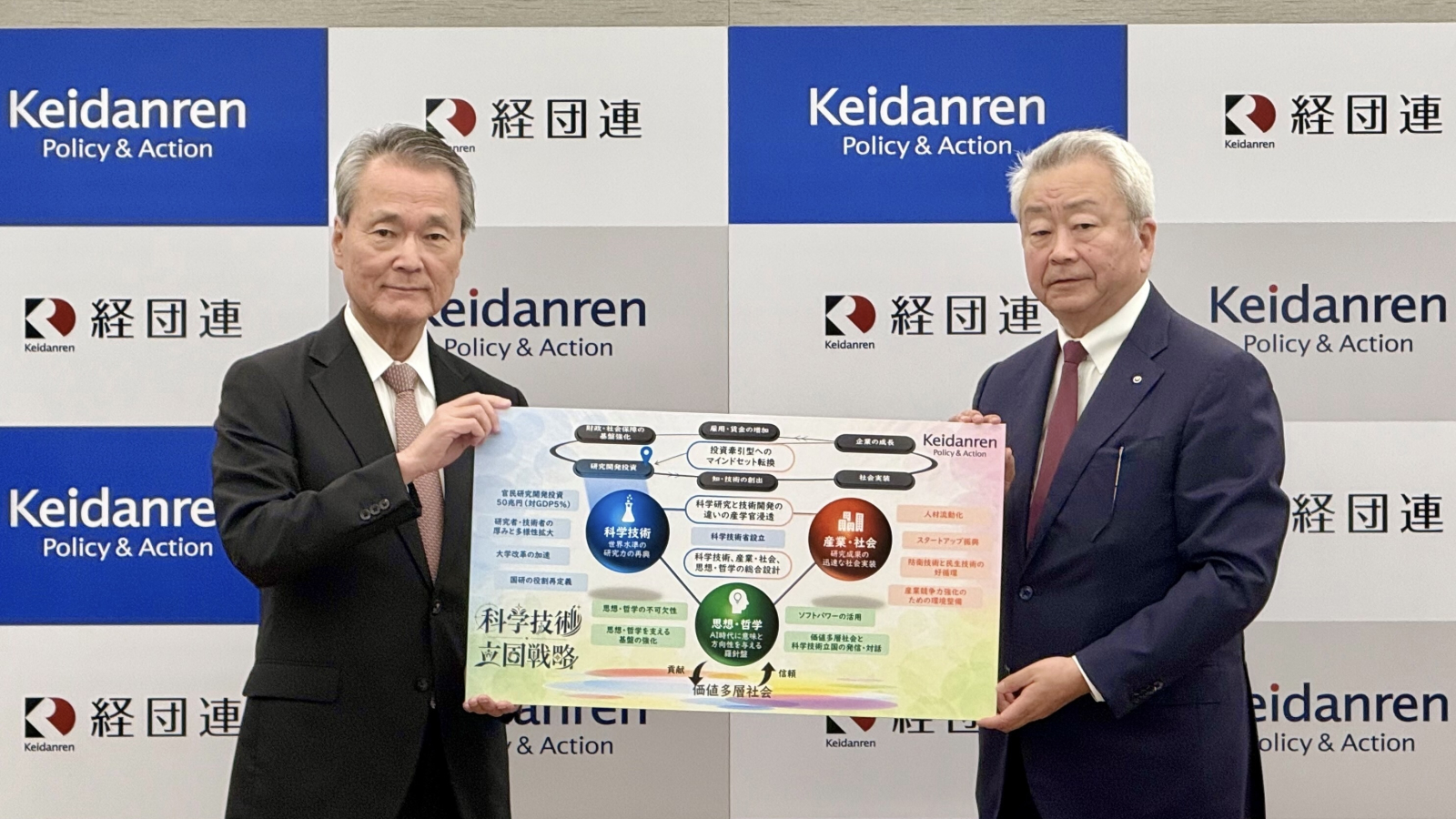
Keidanren (Japan Business Federation) released a policy proposal to the government titled the “Strategy for Creating a Science and Technology-Oriented Nation” On May 11. A major feature of the proposal is that, in seeking to realize a science and technology-oriented nation, it calls not only for expanded investment in “science and technology” and reforms to “industry and society” as the frameworks that receive and make use of the outcomes of such investment, but also for an integrated design that encompasses the role of “thought and philosophy” in supporting them. The proposal also refers to the Kyoto Conference initiative led by the Kyoto Institute of Philosophy (KIP).
Details
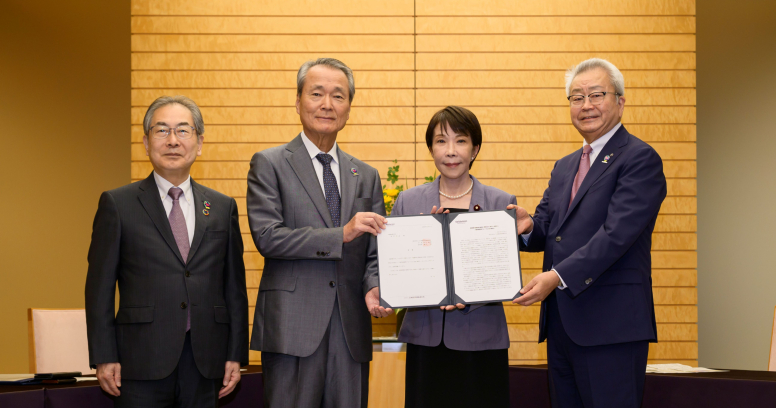
The proposal was compiled under the leadership of Jun Sawada, Executive Chairman of NTT, who serves as Co-Chairperson of KIP, Vice Chair of Keidanren, and Chair of the Special Committee on Science and Technology-Oriented Nation Strategy. Yoshinobu Tsutsui, Chairman of Keidanren, Sawada, and others visited the Prime Minister’s Office and presented the proposal to Prime Minister Sanae Takaichi on May 13
When people think of science and technology policy, attention often focuses on expanding R&D investment and strengthening industrial competitiveness. What stands out in this proposal is that, based on the recognition that technological innovation is entering an era in which it calls into question the very nature of human society, it places the importance of “thought and philosophy” at the center of the discussion.
At the beginning of the proposal, Keidanren describes the history of humanity as a process of opening up new possibilities through science and technology. At the same time, it states that this power has intensified “social risks” such as “the expansion of the damage caused by war,” “the widening of inequality,” “confusion in information,” and “security threats.” The proposal further expresses the concern that these developments have come to shake even human dignity, raising the question of what human beings are fundamentally meant to do. It states that what is now being asked is whether we can “properly recognize both the benefits and risks of science and technology and, based on the goodness inherent in human beings, guide that power in a desirable direction.”
The proposal then sounds a warning about the current international situation, observing that “forces that seek to impose a single set of values and norms” have become increasingly prominent and are giving rise to “conflict and division.” In such circumstances, it argues that what is needed is not “convergence toward a single set of values or order,” but the pursuit of a “Multilayered Society of Values,” in which diverse values coexist in layered and mutually complementary ways. The realization of a Multilayered Society of Values is also one of the guiding ideals of KIP.
Japan is a country that has developed by actively incorporating Western institutions and thought while also maintaining historical and cultural foundations rooted in the East. The proposal argues that Japan should make use of these distinctive qualities and take the lead in building a Multilayered Society of Values within the international community.
In the chapter that discusses thought and philosophy in detail, the proposal states that recent AI technologies, including generative AI, AI agents, and physical AI, raise “challenges of a different order than before” because they may not merely support human activities, but also replace or act on behalf of human judgment and action.
If factories become increasingly automated, what role will human beings play in them, and where will they find meaning in work? In education, even as generative AI advances personalized learning, could it also lead to the homogenization of thinking or a decline in critical thinking skills? In addressing such questions, the proposal states that thought and philosophy indicate “what human beings regard as valuable and what kind of future they seek.” It further makes clear that “thought and philosophy” give “meaning” and “direction” to scientific and technological progress, and constitute an indispensable foundation for creating a science and technology-oriented nation.
In a later section, the proposal calls for the creation of a forum that makes use of Japan’s “distinctive position and strengths” in encompassing Eastern thought as well as Western thought. This forum would bring together global thought leaders, build and communicate a vision for future society through dialogue with thinkers and philosophers, and ultimately connect that vision to global discourse and rule-making. In this context, the proposal states that “the Kyoto Conference initiative led by the Kyoto Institute of Philosophy is highly effective.”
As emerging technologies, including AI, develop rapidly, questions such as what human beings are, what happiness is, and what kind of society we should aim to create will become increasingly important. Keidanren’s reference to the Kyoto Conference in the proposal shows that the business community has come to strongly recognize the need for a forum that addresses such questions.
Photographs courtesy of Keidanren.
Others