Japan Business Federation Highlights Importance of Soft Power in Document to Prime Minister
Keidanren (Japan Business Federation) held its Summer Forum 2026 on July 23 and 24 in Karuizawa, Nagano Prefecture. The forum was chaired by Jun Sawada, Executive Chairman of NTT, who serves as a Co-Chairperson of the Kyoto Institute of Philosophy (KIP) and Vice Chair of Keidanren. The summary proposal adopted at the forum highlights the importance of soft power, including “thought and philosophy,” and emphasizes the need for collaboration between the public and private sectors to further develop Japan’s soft power and strengthen its communication to the world.
Details
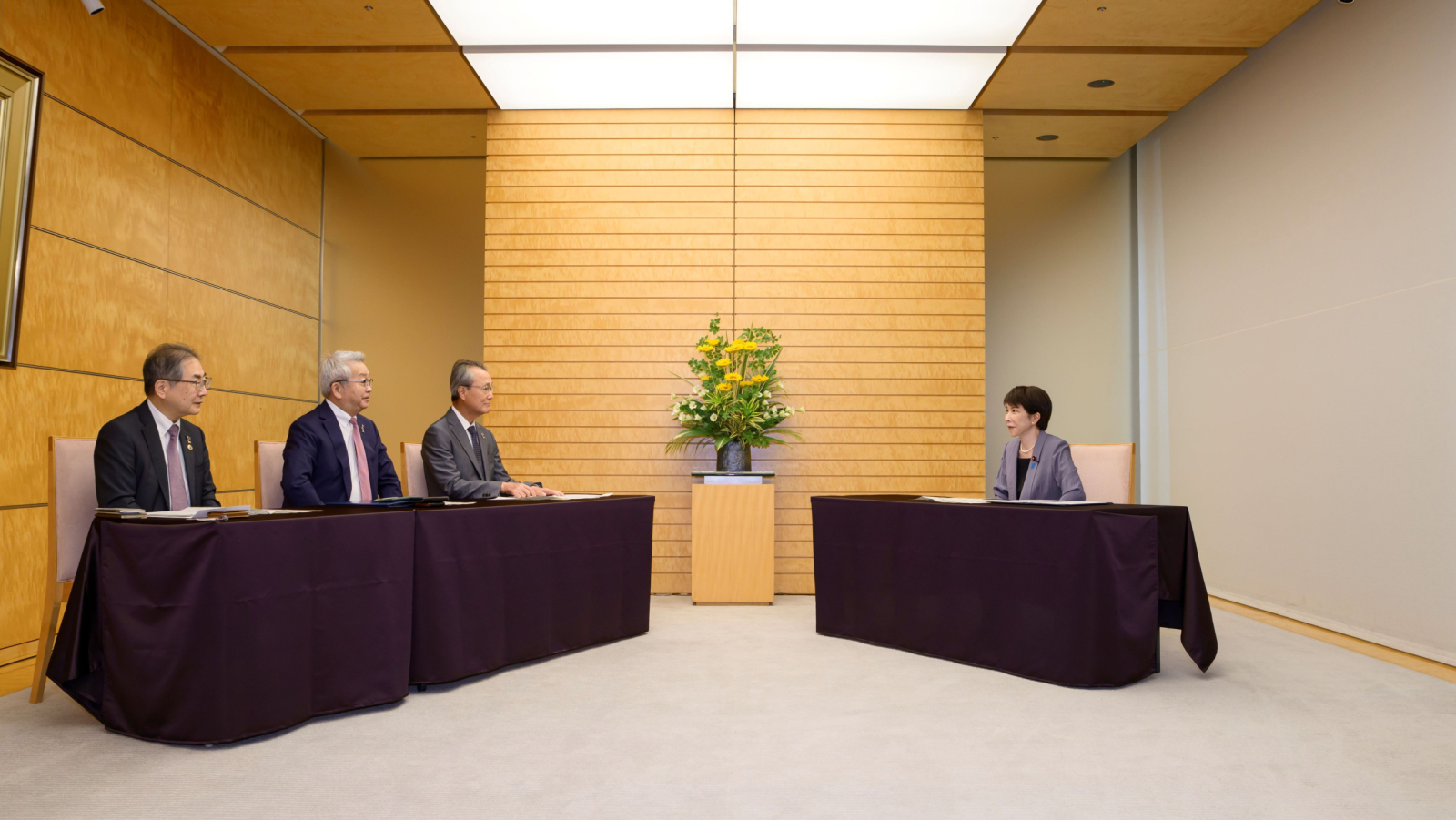
On August 5, Yoshinobu Tsutsui, Chairman of Keidanren, Sawada, and others visited the Prime Minister’s Office and presented the summary proposal to Prime Minister Sanae Takaichi. Keidanren is seeking to transition Japan to an “investment-led economy” and has set a target of expanding domestic private-sector capital investment to 250 trillion yen by FY2040. With particular regard to R&D investment, the summary proposal calls for combined public- and private-sector investment to be raised to a world-leading level of 5 percent of GDP, with annual investment reaching 50 trillion yen by 2040.
The proposal also calls for the business community to actively pursue growth investment that contributes to innovation, as well as for the government to establish a framework that enables science and technology policy and industrial policy to be pursued in an integrated manner. It states that “soft power, including thought and philosophy, design, culture, and content, is important in addressing challenges arising from technological development, promoting the acceptance and social implementation of technology, and fostering international understanding and trust, and is also one of Japan’s strengths.” It further states that “the public and private sectors should work together to actively promote the further development of such soft power and communicate it to the world through compelling narratives.”
In explaining the summary proposal to Prime Minister Takaichi, Sawada referred to the use of AI, saying, “Rather than becoming dependent on AI, humans and AI should make use of each other. Through this, I would also like to redefine the meaning of work.” He also expressed his desire for the public and private sectors to work together to communicate Japan’s strengths in soft power to the world. In response, Prime Minister Takaichi said, “I believe that increased domestic investment will undoubtedly bolster the Japanese economy. Soft power is an area in which Japan is extremely strong and can compete globally, so I intend to work seriously on this.”
Prior to the Summer Forum, Keidanren in May compiled the “Strategy for Creating a Science and Technology-Oriented Nation,” a policy proposal to the government developed under Sawada’s leadership, and submitted it to Prime Minister Takaichi. In seeking to realize a science and technology-oriented nation, the proposal calls not only for expanded investment in “science and technology” and reforms to “industry and society” as the frameworks that receive and make use of the outcomes of such investment, but also for an integrated design that encompasses the role of “thought and philosophy” in supporting them. It explicitly states that “thought and philosophy” constitute “an indispensable foundation for creating a science and technology-oriented nation,” and also refers to the Kyoto Conference initiative led by the Kyoto Institute of Philosophy.
Photographs courtesy of Keidanren.
Others