Kyoto Univ. Professors Discuss Where Academic Inquiry Is Headed in the AI era
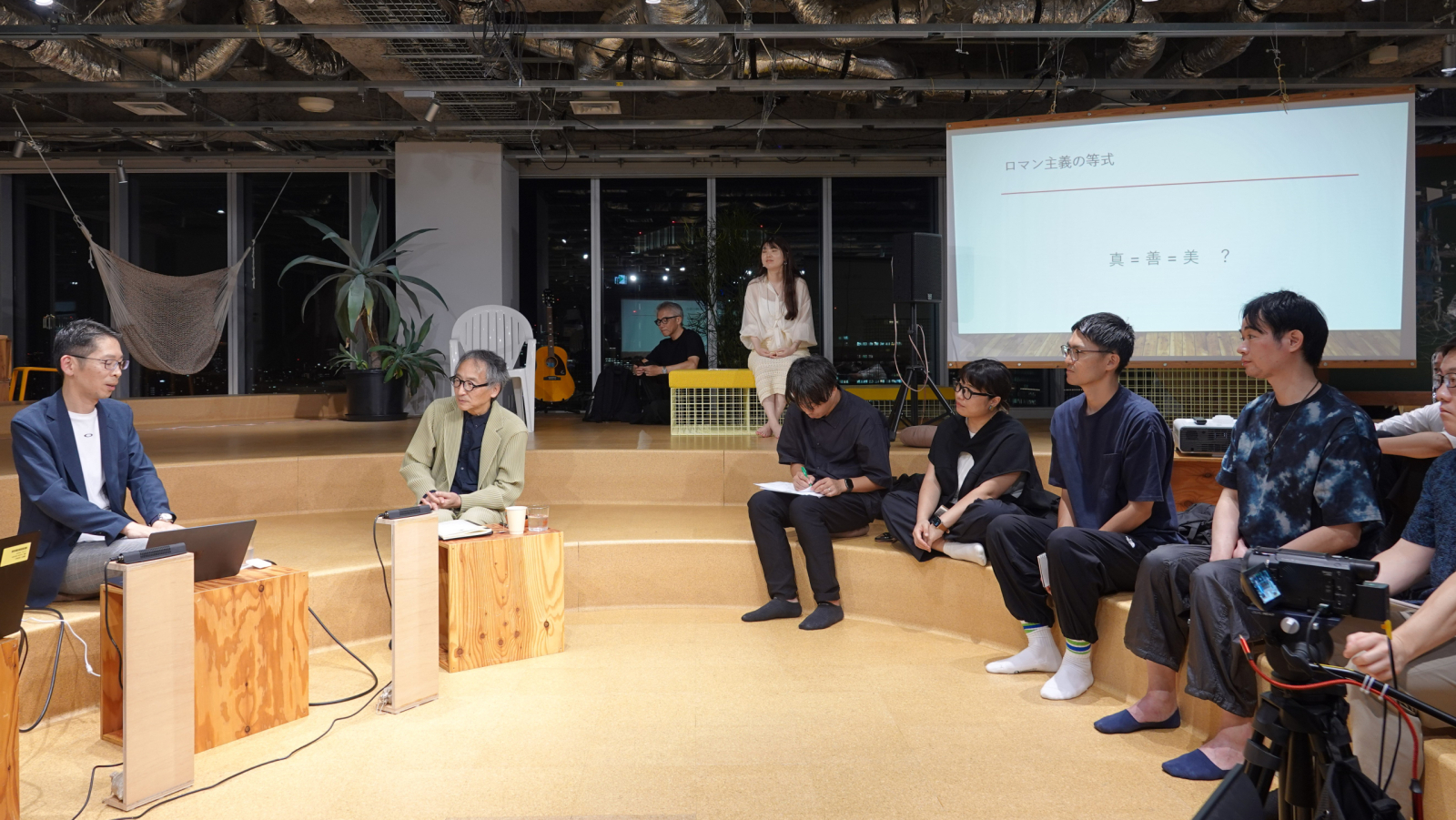
A dialogue event featuring Professor Yasuo Deguchi of Kyoto University, Co-Chairperson of the Kyoto Institute of Philosophy (KIP), and Professor Koji Hashimoto of Kyoto University’s Graduate School of Science was held on August 20 at the UNIVERSITY of CREATIVITY (UoC), located within Hakuhodo’s headquarters in Akasaka, Tokyo. Bringing together perspectives from philosophy and physics across the conventional divide between humanities and sciences, the two professors spent approximately 90 minutes discussing what academic inquiry should look like and where it may be headed as the use of AI continues to expand.
Details
The event was held under the theme “The True, the Good, and the Beautiful and Creativity: Freeing Wonder from the Cage of Knowledge—Where Is Academic Inquiry Headed in the Age of AI?” Toru Takahashi, Director of UoC and Senior Communications Manager at KIP, served as moderator.
Professor Deguchi began by discussing how the word “creator,” originally used to refer to God as the creator of the world, came to be applied to human beings when the German philosopher Immanuel Kant used it in connection with geniuses in scholarship and the arts. As a result, he explained, “creativity,” which had originally referred to the divine act of creating the world, also came to describe the activities of human geniuses themselves created by God.
Professor Deguchi pointed out that throughout the history of scholarship, new ideas that overturn conventional assumptions and claims initially regarded as radically unorthodox have repeatedly emerged and given rise to new paradigms. With the advent of AI, he suggested, we may now be on the verge of another major paradigm shift.
He also cited the prospect of generative AI producing enormous numbers of academic papers, potentially making the existing system of human peer review increasingly difficult to sustain. He suggested that the current academic system itself might eventually dissolve. The question, he argued, is whether what follows will amount to creative destruction or mere destruction, adding that efforts should be directed toward making it the former. He raised the possibility that this moment could offer scholarship a renewed opportunity to challenge established conventions and upend existing frameworks.
Professor Deguchi also noted the dramatic improvement in the quality of texts generated by AI. At the same time, he explained that the core of his own thinking is grounded in experience, life, and memory. He suggested that the ability to generate ideas from scratch by drawing on aspects of those three that have never been documented or put into words may mark an important difference between human beings and AI, which depends on data that has already been expressed in language.
Turning to the idea of “the true, the good, and the beautiful,” Professor Hashimoto considered what might happen as AI increasingly participates in the scientific pursuit of “the true.” AI, he suggested, may autonomously discover and bring into the world scientific theories that human beings do not find beautiful. Science has traditionally pursued truth through beauty, he explained, but if beauty is no longer necessary, scholarship itself may become something fundamentally different.
On the use of AI, Professor Hashimoto observed that while AI can be highly useful, it can also obscure other dimensions through arbitrary quantification. He therefore emphasized the importance of establishing an appropriate division of labor between human beings and AI in academic inquiry and carefully considering what AI should be used for.
The discussion also touched on plans at Kyoto University to establish a research hub where scholars from different fields can examine the value of academic inquiry in the age of AI. Both Professor Deguchi and Professor Hashimoto are involved in the initiative. Professor Hashimoto noted that the spread of AI has naturally begun to create exchanges among faculties that previously had relatively little interaction, suggesting that the emergence of such a cross-disciplinary hub may be almost inevitable.
The two professors concluded their dialogue by expressing their hopes for the creation of a new generation of science and scholarship.
Others