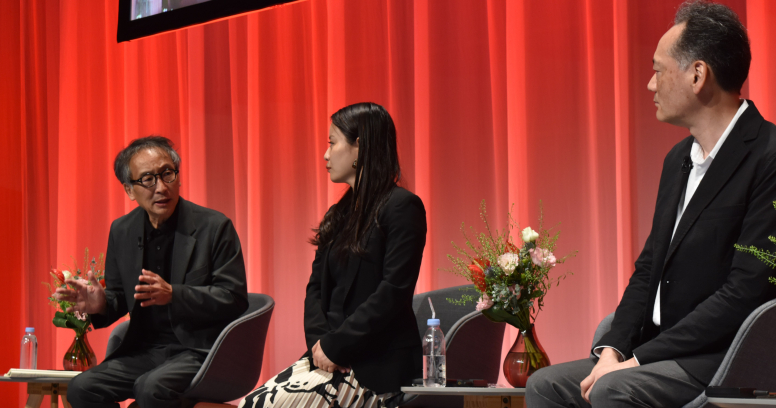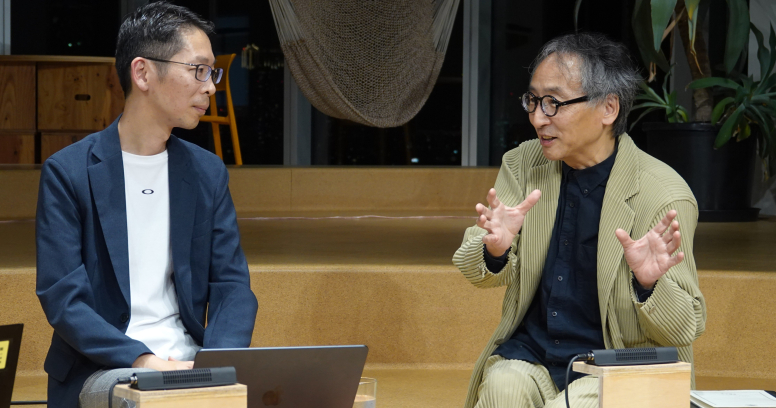
Executives of Kyoto Institute of Philosophy Discuss Human Values and Role of Philosophy in Age of AI at Conference in Germany
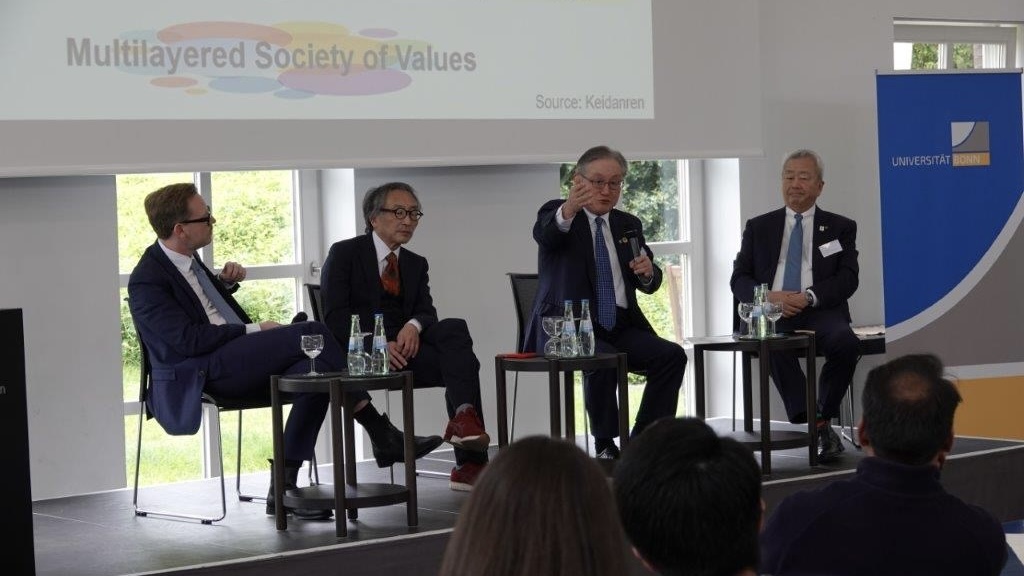
A featured panel discussion organized by the Kyoto Institute of Philosophy (KIP), titled “Toward the Realization of a Multilayered Society of Values,” was held on May 19 at the University of Bonn in Germany as part of the 2nd Desirable AI Conference, “Irrationality and the Age of AI: Language, Ethics, and the Future of Human Expression.” Approximately 100 researchers from Germany and abroad gathered at the venue to discuss human values and the role of philosophy in the age of AI.
Details
The international interdisciplinary conference was co-organized by the Center for Science and Thought at the University of Bonn and the Leverhulme Centre for the Future of Intelligence at the University of Cambridge. Against the backdrop of the widespread adoption of large language models (LLMs), the conference examined from multiple perspectives how AI is affecting human thought, emotion, and linguistic activity.
The KIP panel was moderated by Professor Markus Gabriel of the University of Bonn, KIP’s Senior Global Advisor. The panelists were Professor Yasuo Deguchi of Kyoto University and Jun Sawada, Executive Chairman of NTT, both of whom serve as Co-Chairpersons of KIP, as well as Toshiaki Higashihara, Executive Chairman of Hitachi and a Director of KIP.
At the beginning of the panel, Professor Gabriel described the challenges facing contemporary society, including climate change, geopolitical conflict, migration, and AI, as “nested crises.” He explained that these crises do not exist independently but are intricately interconnected. Addressing them, he argued, requires a “new Enlightenment” in which philosophers, researchers, business leaders, and others collaborate across disciplinary boundaries. He described KIP, which brings together philosophers and leaders from industry, as perhaps the largest collaboration of its kind in the world.
Professor Deguchi, the first panelist to speak, explained why an organization such as KIP had emerged in Japan through the concept of multiple identity crises.
The first is an existential crisis confronting all of humankind in the age of AI. With the emergence of intelligent agents capable of surpassing human beings, he argued, it has become impossible to avoid asking whether there will be anything left for humans to do. The second crisis exists at the level of companies and business, and the third at the level of society as a whole.
Professor Deguchi focused in particular on how much postwar Japan had accepted values such as universal human rights and the Sustainable Development Goals (SDGs) as ideas given to it from outside. He argued that these values should be redefined and put to renewed use from the depths of Japan’s own cultural and spiritual traditions and philosophical thought, rather than simply being treated as something received from others.
He further explained that identity is an answer to the question of who one is. This is not merely a descriptive question, he said, but a normative one concerning what kind of person one ought to become.
Professor Deguchi then introduced the WE-turn advocated by KIP. This represents a shift from “I do” to “We do.” No one can accomplish anything entirely alone, he argued, and every action is ultimately a collective action performed as a member of a “We.”
Higashihara then gave a presentation on why business leaders need philosophy.
Hitachi operates social infrastructure businesses in areas such as railways, power transmission, and factory automation. More than 60 percent of its approximately 290,000 employees are from outside Japan. In an era when people of diverse nationalities, cultures, religions, and values must work together as a single team, he argued that rules and regulations alone cannot bring people together.
Higashihara introduced Hitachi’s mission, which has been passed down since its founding in 1910: “Contribute to society through the development of superior, original technology and products.” He also discussed the company’s founding values of “Harmony, Sincerity and Pioneering Spirit.” In light of this, he emphasized the need to engage with philosophical questions about what it means to be human, what trust is, and how people can coexist.
He also observed that companies can no longer expect the support of society by focusing solely on maximizing profits. Unless they place environmental, social, and human value at the heart of management, they will cease to be attractive to customers, investors, and talented employees. As AI and robots continue to transform human work, he argued, the role of management philosophy is to keep asking what the true value of human beings is and whether ultimate efficiency really leads to human happiness. The society of the future, he stressed, should be designed by human beings.
Sawada spoke about efforts to connect philosophy with social practice. As Vice Chair of Keidanren and Chair of its Committee on a Science and Technology-Oriented Nation, he had shortly before the conference presented Japanese Prime Minister Sanae Takaichi with a policy proposal aimed at creating a virtuous cycle of economic growth driven by science, technology, and innovation.
Sawada explained that a distinctive feature of the proposal was its inclusion of the perspective that science and technology must take philosophy into account. While the relationship between science and industry is widely discussed, he noted, philosophy is rarely given a clear place within that relationship. He described this insight as one of the important outcomes of the first Kyoto Conference.
He also likened science to the fire given to humanity by Prometheus, describing it as an ambivalent force with both beneficial and harmful dimensions. This is precisely why philosophy is needed to help society engage carefully with its power, he argued.
Amid population decline, resource constraints, and growing divisions within the international community, Sawada also introduced the vision of placing science and technology at the heart of a national strategy while seeking to build a “Multilayered Society of Values” that can earn the trust of the international community. This vision is also reflected in Keidanren’s proposal. During the discussion, he further referred to the need for Ethical Capitalism as an evolution of conventional capitalism.
The question-and-answer session that followed featured a lively exchange on topics including the relationship between values and products and the emergence of new forms of value in the age of AI.
In response to a question about what values are, Professor Deguchi described them as vectors or arrows that give direction to our bodily actions. He added that one of the roles of philosophers is to articulate and clarify values that already exist.
A participant also referred to changes among younger generations who are forming their sense of self through dialogue with AI, and suggested that different sectors of society, including science, industry, and politics, should come together to think and deliberate. In response, Higashihara emphasized the need to consider what kind of society should be designed for 2040 and 2050 and to work toward the creation of a human-centered society.
The discussion in Bonn provided KIP with an opportunity to present its efforts within an international and interdisciplinary forum: reconsidering fundamental values in the age of AI and, from that perspective, reimagining the future of society and the world.
Why are leaders in industry now placing such importance on philosophy? Why is cross-disciplinary collaboration grounded in philosophy necessary?
As KIP continues its preparations for the second Kyoto Conference and the “Kyoto Declaration,” it will continue to explore answers to these questions.
Others