Dialogue: Professor Yasuo Deguchi (Kyoto University) × Ory Yoshifuji (CEO, Ory Laboratory) — Part 2 —: Vulnerability of human bodies shapes ethical perspective
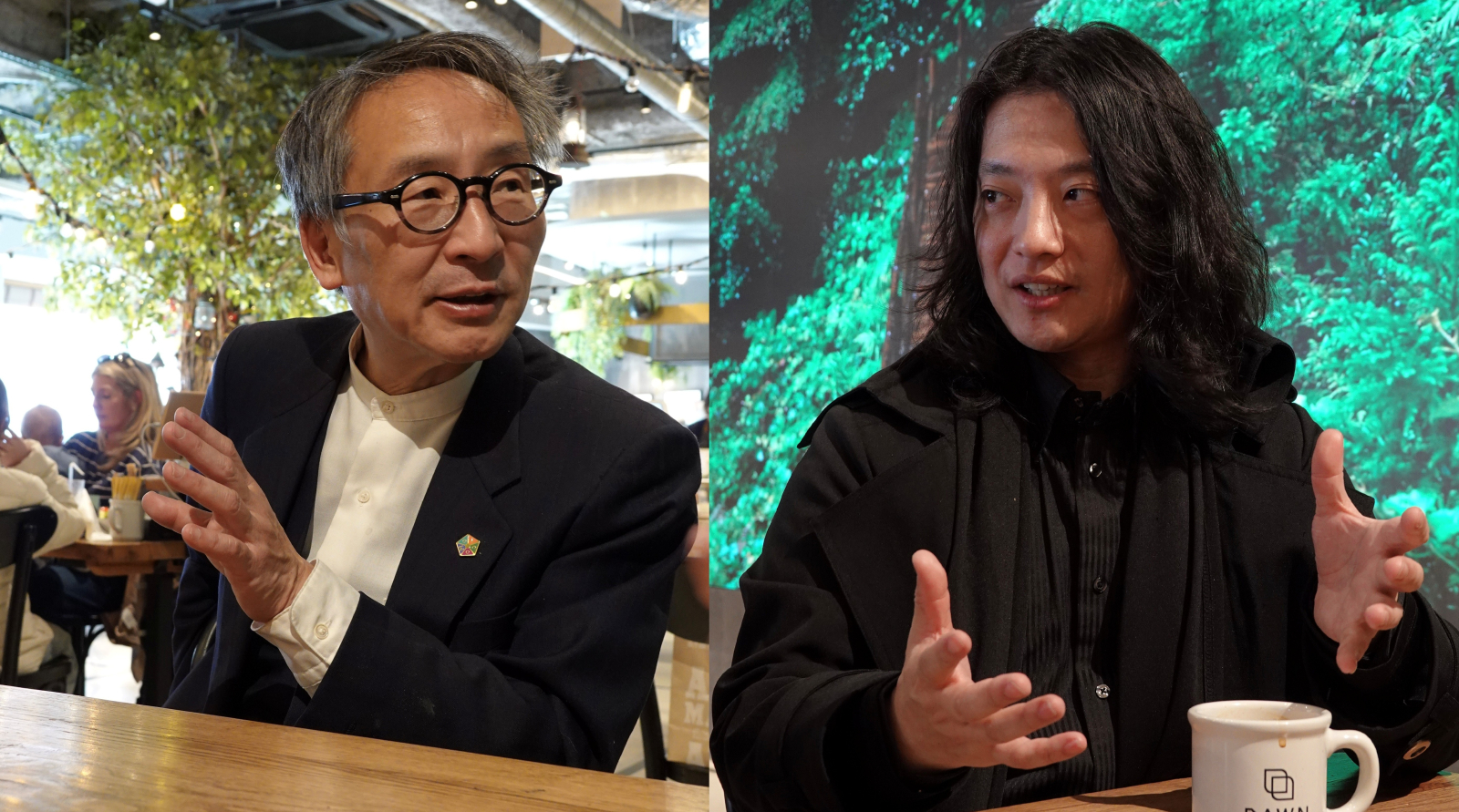
Professor Yasuo Deguchi, Co-chairperson of the Kyoto Institute of Philosophy and professor at Kyoto University, visited the Avatar Robot Cafe DAWN ver.β in Nihonbashi, Tokyo. There, he engaged in a dialogue with Ory Yoshifuji, Co-founder and CEO of Ory Laboratory, the developer of the "OriHime" avatar robot. This article is the second installment in a three-part series (Part 2 of 3).
Details
How Wounds and Pain Shape Human Growth
Yoshifuji: May I ask you something, Professor Deguchi? You often use terms such as “bodily action” (somatic action) and “collective bodily action.” I find it interesting that the word “body” appears in both expressions. Why “collective bodily action” rather than simply “collective action”? Is the body really that important?
Deguchi: In my view, there is no such thing as collective action without the body. In the end, all action necessarily involves the body. Some people believe that action can exist without the body, but the body has simply become invisible to them.
Yoshifuji: Invisible?
Deguchi: In other words, people merely feel as though they can act without the body. But if you look closely, the body is always there. Even thinking, for example, cannot happen without the brain, which is itself part of the body. And what is essential about the body? If you cut it, it bleeds and feels pain. The body is not made of steel; it carries vulnerability within it. In fact, the same is true of OriHime. As an electronic device, it may at times be even more fragile than the human body. It too is vulnerable, or fragile.
Yoshifuji: Then if human beings were disembodied beings incapable of being hurt, collective bodily action would never arise?
Deguchi: Exactly. Collective bodily action is something we engage in while exposing our vulnerable bodies to one another. And when we engage in collective bodily action, we must care for the other person. That is where ethics emerges. The most fundamental basis of morality and ethics lies in the fact that we are all vulnerable beings. If cut, we bleed. The wound may eventually heal, but sometimes a scar remains.
Yoshifuji: From childhood, we inevitably hurt one another to some extent as we live our lives. The people we are today are the result of those experiences. If we were placed in a condition where we could never hurt one another, perhaps we would also lose opportunities for human growth.
Deguchi: In that case, imagination would no longer emerge. In that sense, experiences of collective bodily action are especially important during childhood. Someone falls down, starts bleeding, and cries in pain. Another person reaches out a hand to help. That is the most fundamental experience of the We.
Yoshifuji: Can the We itself also be wounded?
Deguchi: When collective bodily action becomes impossible, the We collapses and fragments into isolated I’s. That is exactly what happens when relationships break down and things stop working.
Yoshifuji: Things fail even when people try to work together. We experience many moments in everyday life that make us aware of the vulnerability of the We.
Deguchi: I think the decisive difference between participating in a remote meeting through a computer or smartphone and communicating through OriHime is that the body steps into a zone of risk. OriHime does not merely appear on a two-dimensional screen. It stands physically before you in three-dimensional space. You could reach out and touch it. And if someone behaved roughly, there would be a real possibility of damaging or breaking OriHime. That would also mean harming the pilot’s embodied presence. Precisely because such risk exists, genuine interaction becomes possible, and a genuine We can emerge.
How Bodily Action Makes the Self Present
Machun: Listening to both of you, I feel that OriHime allows my bodily actions to become visible and present.
Yoshifuji: The pilots who remotely operate OriHime are not anonymous. Their photographs or portraits, along with their pilot names or nicknames, are shown to customers. By making that information public, the pilots expose not only their bodily presence but also something of their personalities and feelings. Customers may like them or dislike them. In that sense, they are taking a step further into genuine human interaction.
Deguchi: What distinguishes OriHime from a mere avatar lies in its movements: the movement of its hands, the movement of its head, the act of nodding up and down. We perceive these as bodily actions. The pilots are the agents of those bodily actions — in other words, bodily actors. In my philosophy, the bodily actor is the self. Machun’s self is appearing here and now through OriHime.
Yoshifuji: Right now, Machun is nodding while listening to Professor Deguchi. But if those movements were generated by AI and moved independently of Machun’s own intentions, then they would no longer be a manifestation of the self. Likewise, if someone else were secretly operating OriHime while pretending to be Machun, that would not be the self either. Only when it is guaranteed that the movement truly belongs to Machun does the self emerge.
Deguchi: Some people may describe this as a form of pseudo-bodily action mediated through a robot. But as long as Machun remains the acting subject, the self is genuinely present here. That is what distinguishes OriHime from a mere avatar.
Yoshifuji: I want to ask you something, Machun. If we fed all the data from your interactions at the café into an AI system — when you raise your hand, when you shake your head, the ways you talk with customers — it might actually be quite easy to create a machine-learned “Machun-droid.” Imagine having many Machun-droids, capable of talking to hundreds of people while you sleep, with the income still going to you. Would that be a world you’d actually want?
Machun: My instinct is that I would not want that — that it would not make me happy. But if you ask me why, I’m sorry, I still can’t quite put it into words yet ...
Yoshifuji: Sometimes, when we conduct experiments at the Avatar Robot Café, people say to us, “So what you’re really doing is training AI, right?” Even overseas, people are remotely operating robots to do housework and using that data to train AI. In the same way, people ask whether this café is also training customer-service AI.
Deguchi: And this is precisely where embodiment becomes essential. It may eventually become possible for machine learning to reproduce countless patterns of customer interactions, perhaps even more skillfully than the original person. But then the question becomes: what gives the original its meaning? In the end, it is the body. Its irreplaceability, its vulnerability, and its finitude — the fact that it will inevitably come to an end. That is the decisive value that distinguishes human beings from AI.
Yoshifuji: Come to think of it, people often say surprisingly cruel things to AI agents and conversational AI systems. I think that is because they do not recognize vulnerability or fragility in AI. It is precisely because the other is fragile and finite that human beings are capable of kindness. I really feel that.
Others