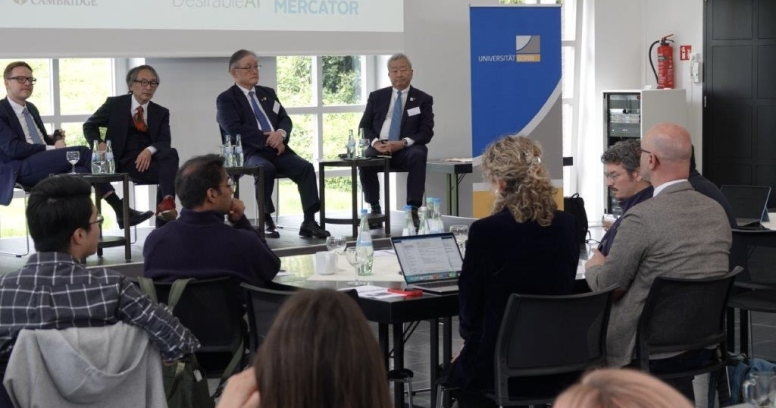
Can Philosophy Change Society? Professors Deguchi and Gabriel Discuss How Philosophy Can Help Shape Better Future and Society
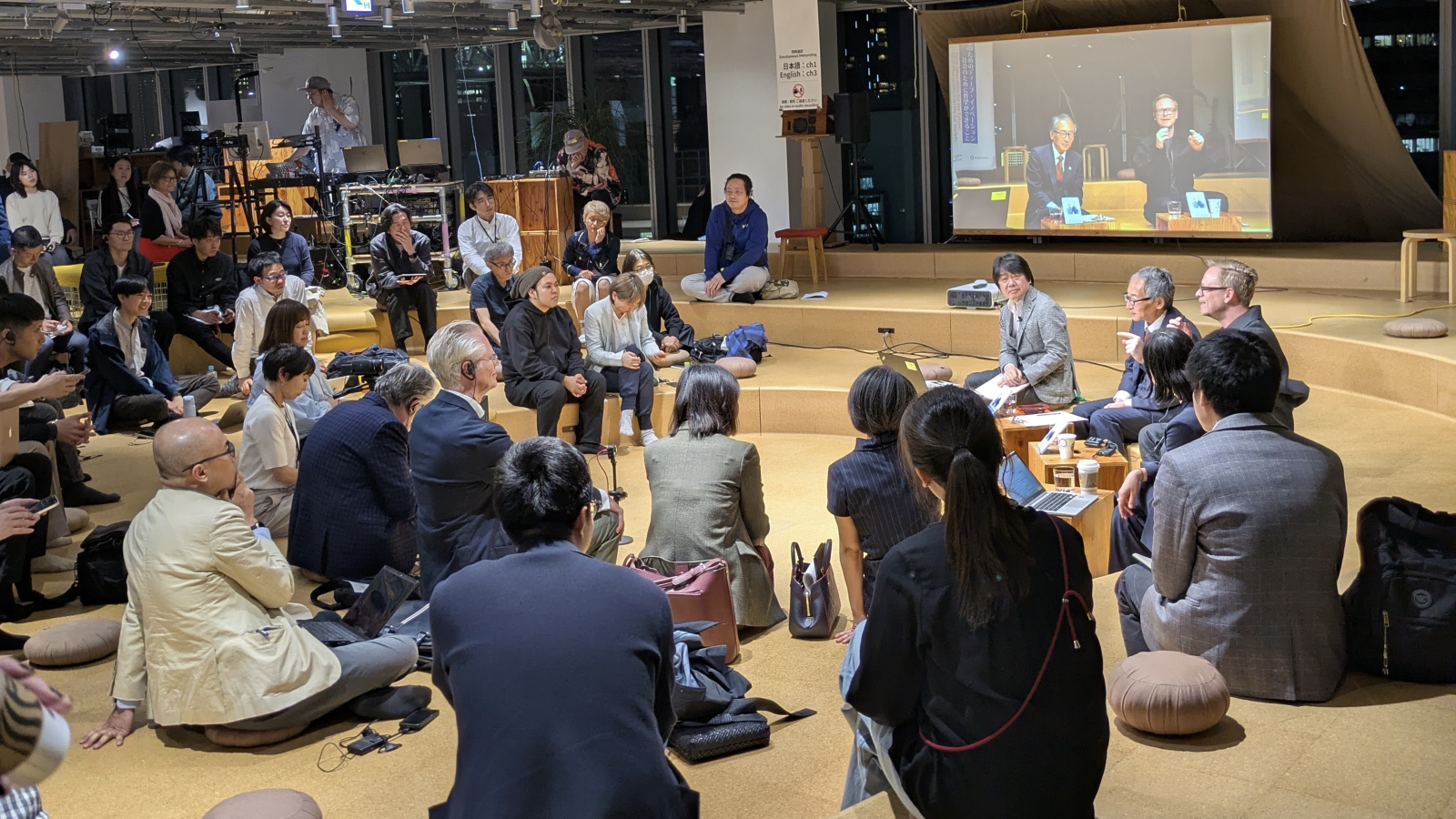
A dialogue event featuring Professor Yasuo Deguchi of Kyoto University, Co-chairperson of The Kyoto Institute of Philosophy (KIP), and Professor Markus Gabriel of the University of Bonn, KIP’s Senior Global Advisor, was held on April 17 at UNIVERSITY of CREATIVITY (UoC), located within Hakuhodo’s headquarters in central Tokyo. The venue was filled with about 90 participants, who engaged in lively discussions on the role of philosophy in contemporary society.
Details
The event was organized to celebrate the publication of the two professors’ co-authored book, What Philosophy Can Do for Future Society: New Moral Realism and We-Turn (Kobunsha Publishing). Focusing on the increasingly complex challenges of contemporary society — including AI, democracy, and environmental issues — the two scholars spent about 90 minutes discussing how philosophy can help shape a better future and society.
Professor Deguchi argued that philosophy alone cannot change society. Rather, meaningful change becomes possible only through collaboration among stakeholders from government, industry, academia, and civil society. He explained that this conviction was one of the motivations behind the establishment of KIP.
Professor Gabriel described contemporary society as an age of “nested crises.” He argued that challenges such as climate change, AI, the destabilization of liberal democracy, and geopolitical tensions are deeply interconnected. Misinformation and polarization driven by AI, for example, can undermine democratic institutions and contribute to international conflict. Likewise, discussions that begin with climate change inevitably lead to questions concerning energy, war, and AI.
In such an era, he suggested, conventional “business as usual” approaches are no longer sufficient. He emphasized the importance of “recoupling” the humanities, the sciences, and engineering, while also highlighting the need for collaboration across fields including business, the arts, and the media. He further introduced the concept of Ethical Capitalism, in which companies create value by addressing ethical challenges.
Turning to AI, Professor Gabriel characterized it as a “magic mirror” that reflects human thought and behavior. In his view, AI also reflects the biases and desires embedded within human society. Rather than replacing human judgment, he suggested that AI could serve as a “friend of humanity,” supporting people in making better decisions.
While Professor Gabriel emphasized the need for cooperation among philosophy, business, and AI in responding to complex crises, Professor Deguchi approached the issue through the lens of WE-turn. He proposed that by rethinking society not in terms of the individual “I” but in terms of the collective “WE,” relationships among human beings, society, nature, and AI can be understood in new ways. Human beings cannot live alone, he noted, but depend on others, nature, and technology. He therefore invited the audience to consider whether what appears to be an individual action is, in fact, a form of collective action carried out by a WE.
Professor Deguchi also addressed the dangers that arise when the WE becomes fixed and closed. In order to avoid the emergence of a “bad WE” characterized by authoritarianism or peer pressure, he introduced the concept of an “empty-centered WE,” in which no single value system permanently occupies the center. He further suggested that AI need not be controlled solely by humans, but could instead become a “co-adventurer” that helps reveal mutual biases.
In the question-and-answer session, a participant asked how ancient traditions of thought might be applied to contemporary problems. Professor Deguchi explained that while he draws inspiration from Buddhism, Daoism, and other philosophical traditions, what matters is not simply presenting those traditions as they are, but rearticulating their insights in language that speaks to the present.
At the conclusion of the event, Toru Takahashi, Director of UoC and Senior Communications Manager at KIP, who served as moderator, introduced a phrase that appears at the beginning of the professors’ new book: “Let us become good ancestors for future generations.” In an era of rapid AI development and growing international uncertainty, the event concluded with a shared message: above all, it is important not to give in to despair.
Others
Japan Business Federation Highlights Importance of Soft Power in Document to Prime Minister
2026.09.01
Kyoto Institute of Philosophy Exchanges Views on ‘Kyoto Declaration’ with Prof. Edward Freeman
2026.07.24