Corporate executives exchange views with Prof. Gabriel at seminar for special supporting members
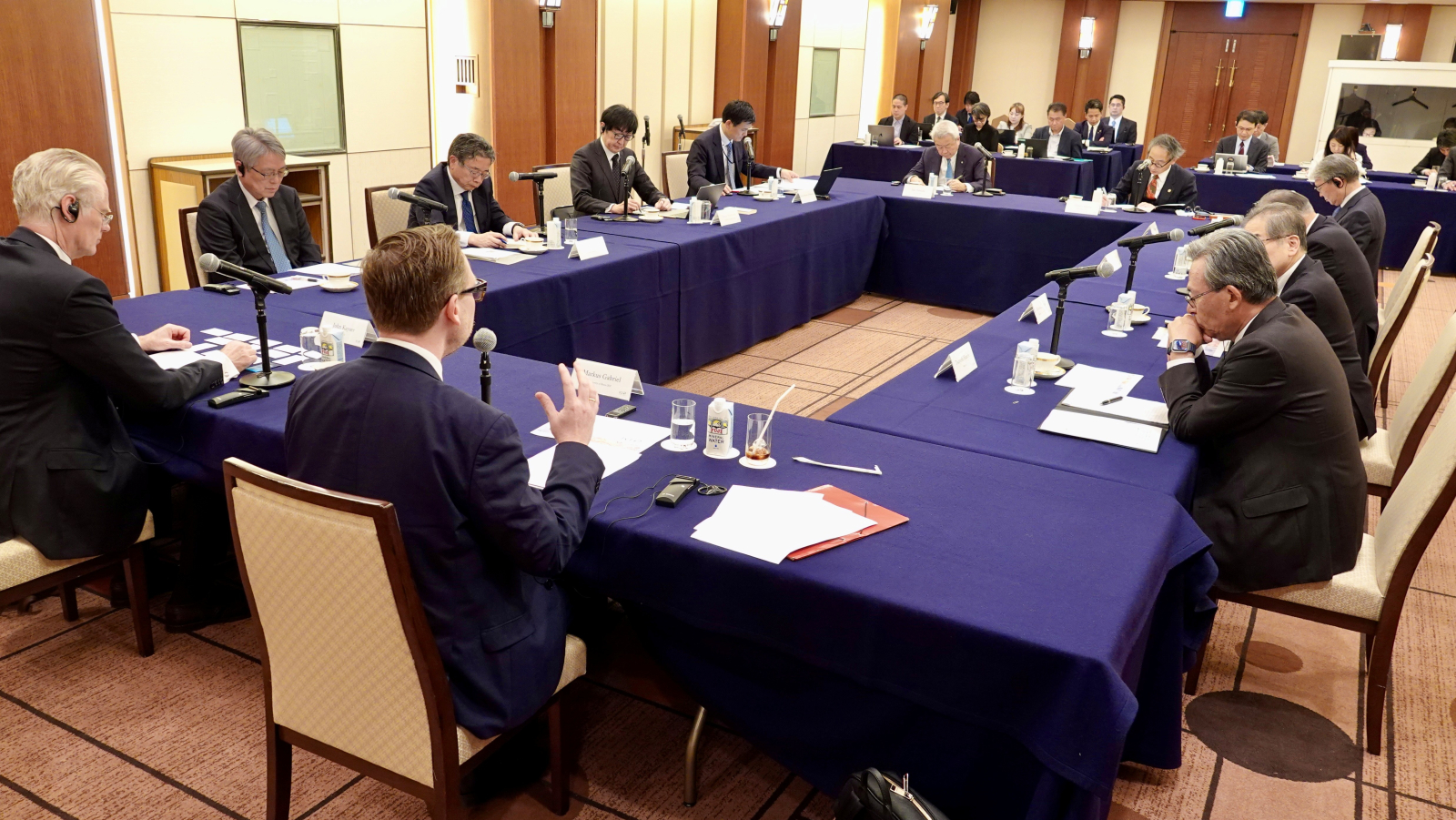
The Kyoto Institute of Philosophy (KIP) held its second seminar for Special Supporting Members on April 16 at the Imperial Hotel in central Tokyo, welcoming Professor Markus Gabriel of the University of Bonn, who serves as KIP’s Senior Global Advisor. Centered on the theme of “moral innovation,” a concept proposed by Professor Gabriel, the seminar brought together senior executives from member companies for three hours of discussion.
Details
KIP offers a range of benefits to its Supporting Members according to their membership category. As with the first seminar held in October 2024, this event was exclusively open to Special Supporting Members. In addition to KIP’s two Co-chairpersons—Professor Yasuo Deguchi of Kyoto University and Jun Sawada, Executive Chairman of NTT—the seminar was attended by three KIP directors: Toshiaki Higashihara, Executive Chairman of Hitachi; Yasuo Nishiyama, President of Hakuhodo DY Holdings; and Toshikazu Yamaguchi, President of The Yomiuri Shimbun Holdings.
The seminar began with a lecture by Professor Gabriel. While advancing his view that business is fundamentally about “doing good,” he explained that the moral innovation he advocates “involves the emergence of new moral facts as a result of changes in social and technological conditions. It generates new normative demands by transforming the structure of values.” At the same time, he argued that emerging technologies such as AI and quantum computing “cannot function effectively without ethical constraints and principles.” He emphasized that interdisciplinary initiatives such as those undertaken by KIP are essential for examining what kinds of ethical constraints should guide the development and use of these technologies.
During the subsequent question-and-answer session, participants raised a wide range of topics. Questions included whether AI might discover new pathways through impasses that humans alone are unable to resolve, and what possibilities could emerge through collaboration between humans and AI. One participant asked whether it is undesirable for humans to regard AI as an authority and simply follow its guidance, or whether AI should instead be understood as a “fellow,” in the sense suggested by Professor Deguchi. Professor Gabriel responded thoughtfully to each question. Participants also exchanged views with an eye toward the second Kyoto Conference, scheduled for the summer of 2027, and the “Kyoto Declaration,” the announcement of which is planned for that occasion.
◇
KIP is currently welcoming applications for both Special Supporting Members and General Supporting Members. For details regarding membership benefits and related information, please see the “Supporting Members” section of this website.
Others

Japan Business Federation Highlights Importance of Soft Power in Document to Prime Minister
2026.09.01
Kyoto Institute of Philosophy Exchanges Views on ‘Kyoto Declaration’ with Prof. Edward Freeman
2026.07.24